Incentivised Reviews: What You Can and Can’t Offer

Can you offer a discount or prize for a review? Google bans incentivised reviews; the FTC and ACCC allow narrow exceptions. Here’s exactly what you can and can’t offer.
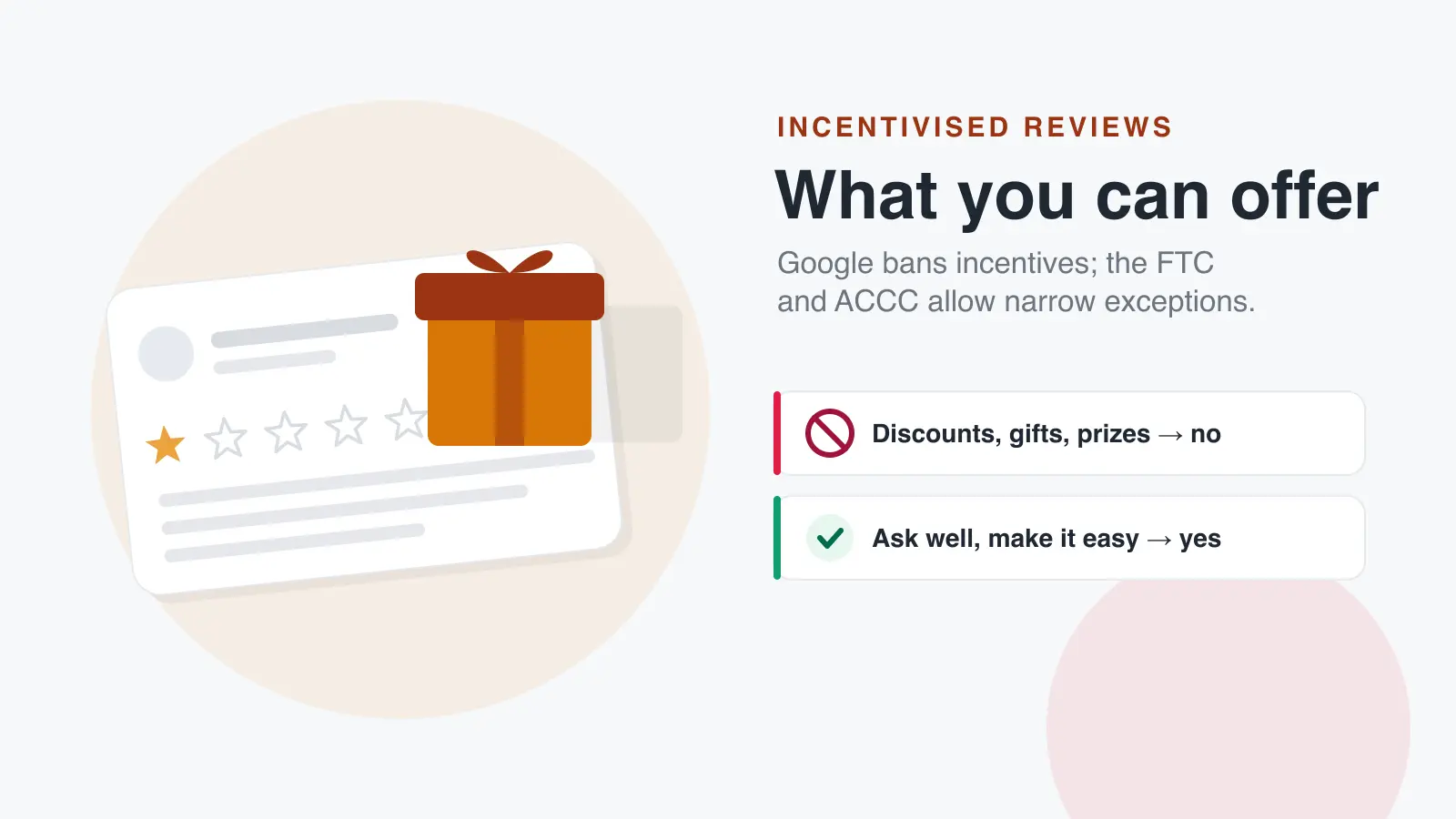
Can you offer customers an incentive to leave a review? On Google, no. Google prohibits incentivised reviews outright, whether the incentive is cash, a discount, a free product, or entry into a prize draw. More broadly, in the United States the FTC's Consumer Reviews and Testimonials Rule restricts incentives that buy or bias reviews, and in Australia the ACCC's position is that any incentive must be offered regardless of whether the review is positive or negative, and clearly disclosed. The safest answer for most businesses is simply: don't.
The temptation is understandable, an incentive reliably lifts your review volume. But the rules here are stricter and better enforced than most business owners realise, and the penalties for getting it wrong are real. This guide lays out exactly what you can and can't offer, across the three authorities that matter.
What counts as an incentive
An incentive is anything of value offered in exchange for a review. It's broader than cash, and this is where businesses trip up. All of these count:
- Money, gift cards, or store credit
- Discounts on a current or future purchase
- Free products, samples, upgrades, or add-ons
- Entry into a prize draw or competition
- Loyalty points or rewards
- Anything conditioned on the review being positive, or on removing a negative one
It doesn't matter whether the incentive is large or small, or whether you ask for a positive review explicitly. Offering a reward for a review is the thing the rules address.
What each authority actually says
Google: a flat prohibition
Google's policy is the strictest and the most relevant, because the review lives on Google. It prohibits incentivised reviews, offering payment, discounts, free goods or services in exchange for posting a review, revising one, or removing a negative one. There's no compliant way to incentivise a Google review. Breaching this can lead Google to remove reviews, disable new reviews on your profile, or display a warning to consumers that fake reviews were detected.
The FTC: civil penalties in the US
The FTC's Consumer Reviews and Testimonials Rule took effect on 21 October 2024. It targets fake and materially misleading reviews, including reviews bought or biased through incentives without proper disclosure, and reviews procured from insiders. Violations can draw civil penalties, up to tens of thousands of dollars per violation. The FTC has already put businesses on notice under the rule.
The ACCC: disclosure and neutrality in Australia
The ACCC's position under the Australian Consumer Law is that offering incentives for reviews risks misleading consumers unless two conditions are met: the incentive is available regardless of whether the review is positive or negative, and the fact that the review was incentivised is clearly disclosed so consumers can weigh it. The ACCC has pursued businesses over misleading review conduct with substantial penalties, including a $2.9 million penalty against HealthEngine.
The one thing you must never do
Whatever you decide about incentives generally, one practice is unambiguously prohibited everywhere: offering anything in exchange for removing or changing a negative review. Paying a customer to take down a bad review, or offering a refund conditional on them doing so, breaches Google's policy and sits squarely within what the FTC and ACCC treat as misleading conduct. If a customer is unhappy, resolve the underlying problem, and if they then choose to update their review, that's their decision, freely made, with nothing conditioned on it.
What you can do instead
You don't need incentives to grow reviews, you need to ask well, and ask everyone.
- Ask every customer, promptly, while the experience is fresh. Timing beats bribery.
- Make it effortless, a direct link or QR code straight to your review page.
- Ask in a way that feels personal, not transactional, a genuine "we'd love to hear how we did" outperforms a reward offer for trust and often for response rate too.
- Respond to reviews, which quietly signals to future customers that leaving one is worthwhile.
The businesses with the strongest review profiles almost never pay for them. They've made asking a consistent, automatic part of every transaction. That's precisely what a compliant tool handles: Dinopix Reviews sends a timely, personal review request to every customer, with a direct link to your public page and no incentive attached, so your review volume grows the way Google, the FTC and the ACCC all require, and the way that keeps your reputation defensible.
Frequently Asked Questions
Can I offer a discount for leaving a Google review?
No. Offering a discount in exchange for a review is an incentivised review, which Google prohibits outright. This holds even if you don't ask for a positive review and offer the discount regardless of rating. Google's ban is on incentivising the review at all, not just on biasing it.
Is a prize draw for reviewers allowed?
Not for Google reviews. Entry into a prize draw is a thing of value, so conditioning it on leaving a review makes it an incentivised review under Google's policy. If you run a competition, keep entry unconnected to leaving reviews.
What if I give the reward to everyone, positive or negative?
That neutrality can satisfy the FTC's and ACCC's concerns about biasing reviews, and combined with clear disclosure it may be permissible for reviews generally. But it does not satisfy Google, which bans incentivised reviews regardless of sentiment. So for a Google review specifically, a sentiment-neutral incentive is still a breach.
Can I offer an incentive if I disclose it?
Disclosure is what the ACCC and FTC require before an incentivised review can be lawful on platforms that permit them, but disclosure doesn't override Google's outright ban. On Google, a disclosed incentive is still prohibited. Disclosure matters most on platforms and channels that allow incentivised, disclosed reviews.
Is it illegal to pay someone to remove a bad review?
It's prohibited and risky. Paying a customer to remove or change a negative review breaches Google's policy and falls within the misleading conduct the FTC and ACCC pursue. Resolve the complaint on its merits instead, and leave any change to the review entirely to the customer.
How do I grow reviews without incentives?
Ask every customer promptly, make leaving a review effortless with a direct link, keep the request personal rather than transactional, and respond to the reviews you receive. Consistent, well-timed asking to your whole customer base reliably outperforms incentives, without the compliance risk.
Sources
This guide draws on the primary sources below. Regulations change. Always check the current version.