Dental Reputation Management

Both HIPAA settlements over review replies hit dental practices. What dental reviews really complain about, and how to fix it at source.
Here is a fact worth sitting with: both of the HIPAA enforcement settlements over responding to online reviews were against dental practices. Not hospitals, not large health systems — dental practices, replying to unhappy patients on Yelp.
That's not a coincidence. Dentistry combines high-value treatment, insurance disputes and a strong new-patient acquisition dependence on reviews, which makes the pull to correct the record unusually strong. This covers how to manage a dental practice's reputation without walking into the same problem.
What happened in the enforcement cases
In December 2022 the HHS Office for Civil Rights settled with New Vision Dental in California for $23,000 over protected health information disclosed while responding to reviews. According to OCR, the practice habitually disclosed PHI when replying to patient posts — sometimes providing patients' full names where the reviewer had used only a pseudonym, and adding detail about visits and insurance the patient had not mentioned. The corrective action plan ran for two years and required removing years of social media posts containing PHI and issuing breach notices to affected individuals.
A separate settlement with Elite Dental Associates resolved social media disclosures of patient information for $10,000.
What dental reviews actually complain about
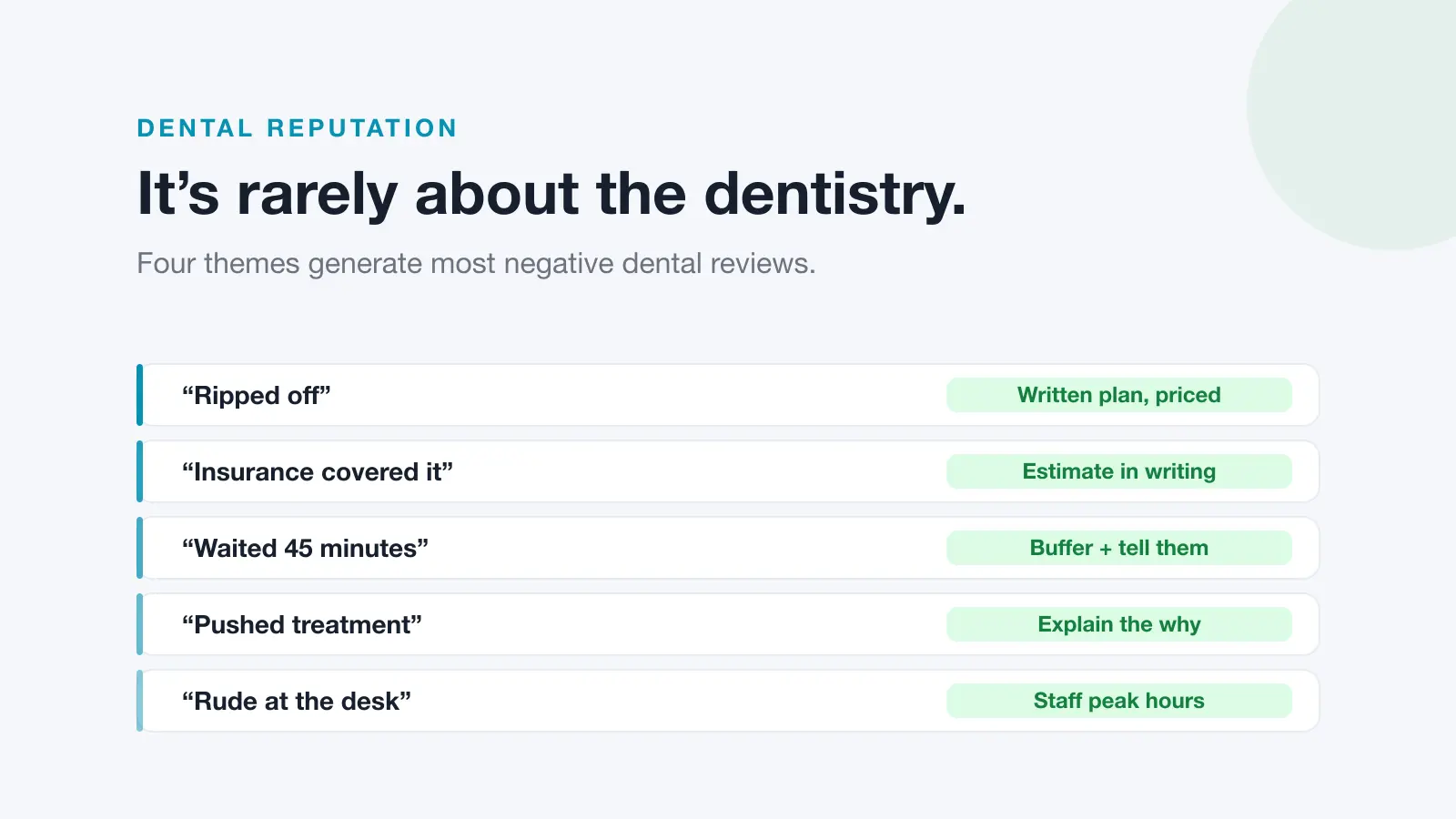
Read a few hundred dental reviews and the same four themes dominate. None of them are about clinical skill, and all of them are addressable — operationally, not in the reply box.
| Complaint | What it's usually about | The operational fix |
|---|---|---|
| "Ripped off" | Cost not made clear before treatment | Written treatment plan with costs, signed before work starts |
| "They said insurance covered it" | Estimate given as certainty | Present coverage as an estimate in writing; confirm before proceeding |
| "Waited 45 minutes" | Scheduling, not clinical | Buffer slots, and tell patients when running late |
| "Pushed treatment I didn't need" | Recommendation without explained rationale | Explain why, offer the option of waiting, document it |
| "Rude at the desk" | Front-of-house under pressure | Staffing at peak, and a script for cost conversations |
Replying safely
The safe reply carries no information. It acknowledges, states the constraint, and moves the conversation offline.
"Thank you for the feedback. Patient privacy rules mean we can't discuss anyone's care or account publicly, but we'd genuinely like to understand what happened. Please call our practice manager on [number]."
Use it for positive reviews too, with warmer wording. "So glad the implant worked out!" confirms both that they were a patient and what treatment they had.
The volume strategy
Since you can't argue, the game is outnumbering. Dental practices are unusually well placed for this and unusually bad at exploiting it — you see patients on a recall cycle, most visits go fine, and almost nobody is asked.
- Ask after routine appointments, not after major treatment where the outcome is still settling.
- Ask every patient in that group. Filtering by who you expect to be positive is review gating, which breaches Google's policies.
- Never incentivise. No discount on the next hygiene visit, no prize draw, nothing.
- Ask patients not to include clinical or personal details. Reviews naming a dentist or describing treatment are the ones Google most often removes under its personal information policy — and they're usually your best ones.
- Send it the same day, by text, with a direct review link.
A practice seeing forty patients a week that asks all of them will out-review a single angry patient within a fortnight. That's the whole strategy, and it's more effective than anything you could have written in reply.
Automating that — same-day requests after appropriate appointments, every Google and Facebook review in one inbox, an approved template ready to post — is what Dinopix Reviews is built for. For the wider clinical-practice picture, see reputation management for doctors.
Frequently Asked Questions
Can a dentist respond to a patient review?
Only in general terms that disclose nothing. Confirming the person was a patient, or referencing their treatment, appointment or insurance, is a disclosure of protected health information. Both HIPAA enforcement settlements over review responses involved dental practices doing exactly that. Acknowledge the feedback, note that privacy rules prevent discussing individual care, and give a phone number.
What were the dental HIPAA review settlements?
New Vision Dental in California paid $23,000 in a December 2022 settlement with the HHS Office for Civil Rights over protected health information disclosed while responding to online reviews, with a two-year corrective action plan. Elite Dental Associates settled similar social media disclosures for $10,000 in an earlier case.
How do dental practices get more Google reviews?
Ask every patient after routine appointments, the same day, by text, with a direct review link. Recall-based practices have a natural, repeated moment to ask that most never use. Never offer anything in exchange, never ask only the patients you expect to be positive, and ask people to describe the practice rather than name clinicians or treatments.
How should I handle a review complaining about cost?
Not in the reply — any explanation of what was charged and why discloses treatment and account information. Handle it privately, then fix the cause: an itemised written treatment plan with costs, agreed before work begins, prevents most cost complaints from ever being written. Cost and insurance are the two most common themes in negative dental reviews.
Can I ask a patient to remove a bad review?
You can resolve their complaint and leave the decision entirely to them, but you must not condition anything on it. Offering a refund, a discount or free treatment in exchange for removing or changing a review conditions an incentive on review sentiment — prohibited by Google's policies and targeted by the FTC's 2024 rule on consumer reviews.
Why did a five-star review of my practice disappear?
Most often because it named the dentist or described treatment, which can breach Google's personal information policy. Google removes these without notifying anyone, and positive reviews are affected as readily as negative ones. Asking patients to talk about the practice and the service rather than individuals reduces how many you lose.
Sources
This guide draws on the primary sources below. Regulations and enforcement guidance change — always check the current version, and take advice on your own obligations.
- HHS Civil Rights Office Enters Settlement with Dental Practice Over Disclosures of Patients' Protected Health Information (New Vision Dental, December 2022)
- Dental Practice Pays $10,000 to Settle Social Media Disclosures of Patients' Protected Health Information (Elite Dental Associates)
- Prohibited & restricted content — Google Business Profile Help
- FTC announces final rule banning fake reviews and testimonials — Federal Trade Commission, August 2024