Hotel Reputation Management

How hotel review platforms differ, why hotel ratings run harsh, and what actually moves the score across Google, Tripadvisor and the OTAs.
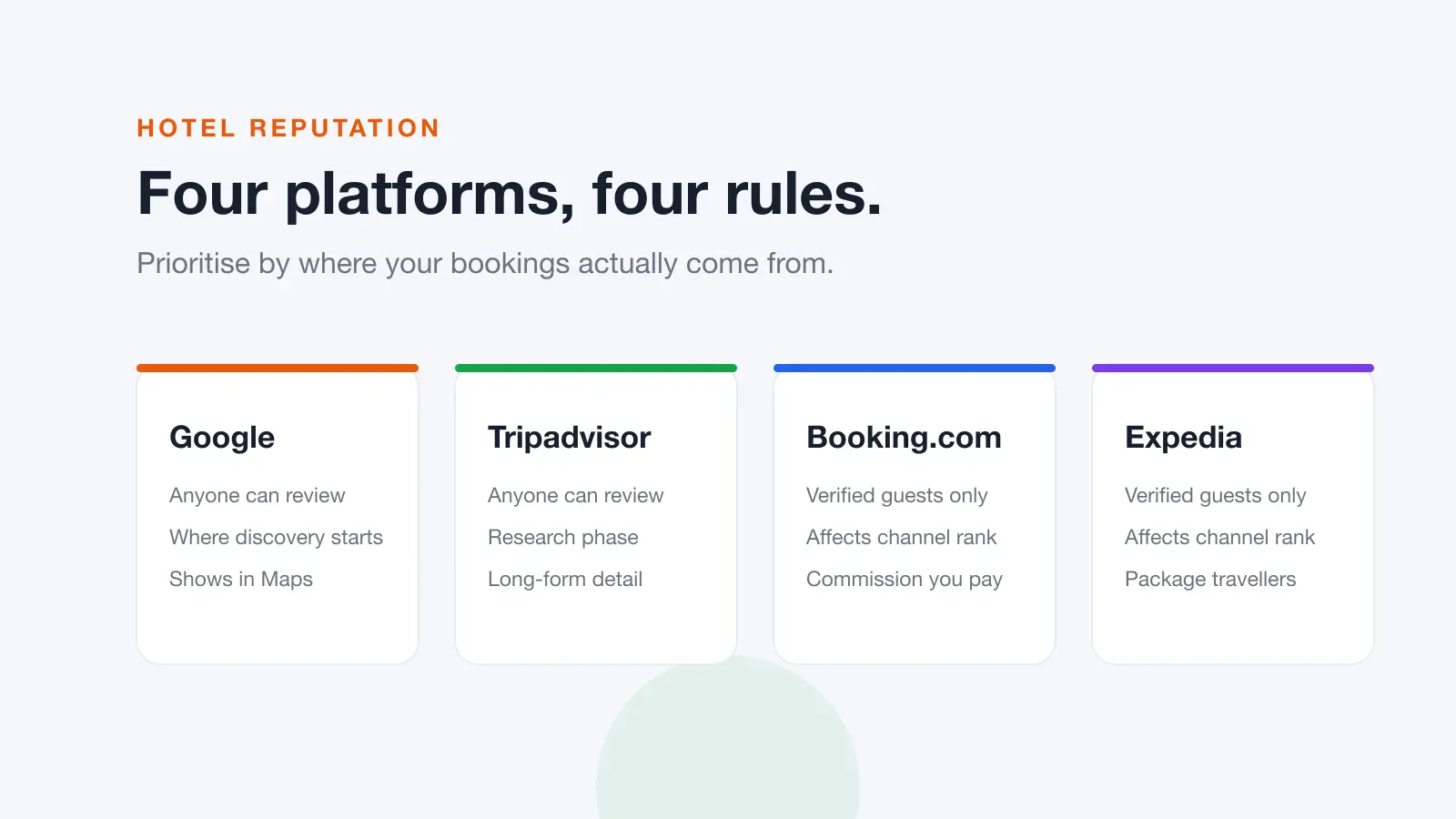
Hotels have the opposite problem to clinics. There's no confidentiality constraint — you can say whatever you like in a reply. What hotels have instead is fragmentation: the same stay can be reviewed on Google, Tripadvisor, Booking.com and Expedia, each with its own rules, its own audience, and its own effect on how much business you get and at what rate.
This covers how the platforms differ, where to put your effort, and what actually moves a hotel's rating.
The platforms aren't interchangeable
| Platform | Who reviews | Why it matters |
|---|---|---|
| Anyone, verified or not | Where discovery starts; the rating shows in search and Maps | |
| Tripadvisor | Anyone claiming a stay | Research phase; long, detailed reviews carry weight |
| Booking.com | Only verified guests who booked there | Directly affects visibility within the channel you're paying commission to |
| Expedia | Only verified guests who booked there | Same — ranking within the channel |
| Direct / on-property | Your own guests | Feeds operations; not public |
The distinction that matters most is verified versus open. On OTA platforms, only someone who actually booked through that channel can review — which makes fake reviews rare and complaints specific. On Google and Tripadvisor anyone can post, which is where most disputes originate.
Why hotel reviews are structurally harsher
Three things push hotel ratings down that have nothing to do with how well you run the property.
Expectations are set by someone else. The OTA listing, the photos and the star classification create an expectation your front desk didn't write. A large share of complaints are gaps between that and reality.
Guests review the whole trip. Traffic, weather, the flight, the town — all of it lands in a review of your hotel.
Everything is compared. Guests review against every hotel they've stayed in, not against other hotels at your price in your location.
None of that is fixable in a reply. What it means practically is that chasing a perfect score is the wrong goal; reducing the recurring, genuinely-your-fault complaints is the right one.
Replying, at volume
Hotels get more reviews than most businesses, so replies have to be fast and templated without reading as templated. The workable structure is four lines: thank them, name the specific thing they mentioned, say what's changing if anything is, and invite direct contact.
The one rule that matters: never argue about the facts of a stay. A prospect reading a defensive reply concludes the hotel is difficult, regardless of who was right about the air conditioning.
Asking for reviews
On OTA platforms the request is automatic and out of your hands. Google is where you have leverage, and where most hotels underperform relative to their actual guest satisfaction.
- Ask at checkout or same-day after departure, while the stay is fresh.
- Ask every guest. Screening by expected sentiment is review gating and breaches Google's policies.
- Never incentivise — no discount on a future stay, no upgrade, no draw entry.
- Use a direct link or QR code at reception and on the folio, so it's one step rather than six.
- Ask guests not to name staff — Google frequently removes reviews naming individuals under its personal information policy, and in hotels those are disproportionately the glowing ones.
What actually moves the rating
In order of effect: fixing the two or three recurring operational complaints, asking every guest so the sample reflects your real quality rather than only the annoyed, resolving problems during the stay while the guest is still on the property, and replying quickly and consistently everywhere. Disputing individual reviews sits far below all of these and often makes things worse.
Keeping that running across platforms and properties is the practical difficulty. Dinopix Reviews brings Google and Facebook reviews into one inbox with sentiment analysed so themes surface without manual tagging, and automates the post-stay request so the asking doesn't depend on a busy front desk remembering.
Frequently Asked Questions
Which review platform matters most for hotels?
Whichever one brings you the most bookings, which varies by property. Google matters universally because it's where discovery starts and the rating appears in search and Maps. OTA scores matter in proportion to the share of business that channel delivers, since they affect visibility within it. Check your own channel mix rather than assuming.
Can hotels remove bad reviews?
Only where a review breaches the platform's policies — for example a review of the wrong property, or one containing personal attacks or irrelevant content. Each platform has its own reporting route and its own decision. No hotel and no software vendor can remove a genuine negative review, and any supplier suggesting otherwise is misleading you.
Should hotels reply to every review?
Reply to every negative review and to a good proportion of positive ones. Consistency reads better than volume: a profile where recent complaints are answered and older ones aren't looks worse than one answered uniformly. Keep replies short, name the specific issue raised, and never argue about the facts of the stay.
Why do OTA scores differ from our Google rating?
Different reviewer pools and different scales. OTA reviews come only from verified guests who booked through that channel, and several use a ten-point scale that converts oddly to stars. Google is open to anyone. A gap between the two is normal; a large gap usually means one channel is attracting a different kind of guest with different expectations.
How do we get more Google reviews for our hotel?
Ask every departing guest the same day, with a QR code at reception and a direct link in the post-stay email. Most hotels rely entirely on OTA-generated reviews and never ask for Google ones, which leaves their most visible rating built on a small, self-selected sample. Never offer anything in exchange, and ask everyone rather than a filtered group.
What should we do about reviews complaining about things we can't control?
Reply briefly and without defensiveness, acknowledging the frustration without accepting blame for the weather or the roadworks. Prospects discount these reviews themselves when the hotel's response is gracious. The mistake is arguing, which turns something readers were already dismissing into evidence that the hotel is combative.
Sources
This guide draws on the primary sources below. Platform policies change — always check the current version.