The Ultimate Review Management Platform Comparison for 2026: Find Your Perfect Solution

The four kinds of reputation management software, the criteria worth checking, the pricing transparency test, and the one feature that should end an evaluation.
Reputation management software is a crowded category where most of the products aren't actually comparable. A tool that texts customers asking for reviews and a tool that analyses feedback themes across two hundred locations both get filed under "review management", and choosing between them on a feature grid produces a decision that makes no sense.
This is a guide to evaluating them properly: what the categories actually are, the criteria worth checking, and the questions that separate a tool that will work for you from one that demos well.
The four categories
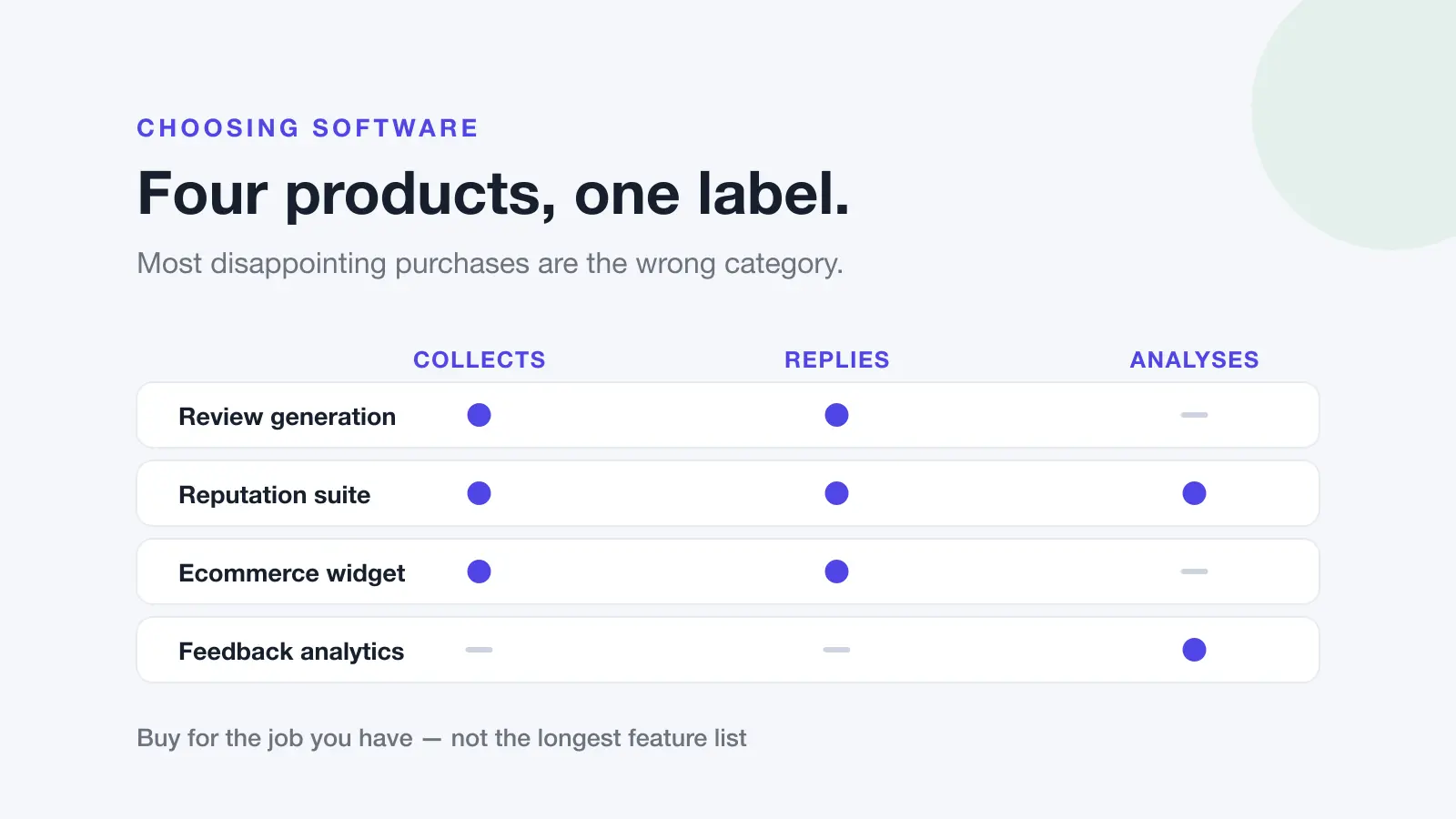
Almost everything in this market falls into one of four groups. They overlap at the edges and are priced very differently.
- Review generation tools. Their core job is getting more reviews: automated requests by SMS or email after a job, review links, QR codes. Strongest for local service businesses whose problem is volume.
- Reputation suites. Broad platforms covering reviews, listings management, messaging, sometimes payments and webchat. Built for multi-location brands; usually sold with a contract and an onboarding process.
- Ecommerce review widgets. Product reviews, photo reviews and on-site display for online stores. These answer a different question entirely — they're about conversion on your own site, not your Google rating.
- Feedback analytics. Tools that ingest reviews, surveys and support tickets to surface themes. They analyse feedback; they generally don't collect it or reply to it.
What to evaluate
| Criterion | The question to ask | Why it matters |
|---|---|---|
| Sources covered | Which platforms does it actually pull from, via official APIs? | Scraped sources break. Google and Facebook coverage is table stakes; industry sites often aren't included |
| Reply capability | Can you reply to Google from inside the tool, or only read? | Read-only tools mean you still work in two places |
| Request automation | Does it trigger from your systems, or does someone press a button? | Manual requests stop happening within about three weeks |
| Multi-location handling | One inbox across locations, with per-location permissions? | The single biggest cost driver, and where cheap tools break down |
| Historical record | Does it keep its own copy of reviews as they arrive? | Without one you can't tell when a review is removed |
| Pricing transparency | Is the price on the website? | See below — this is more revealing than it looks |
| Exit terms | Contract length, and can you export your data? | Annual contracts are standard in this category; check before signing |
| Policy safety | Does it offer any form of sentiment filtering before asking? | A hard disqualifier — see below |
The pricing transparency test
A useful shortcut: check whether the vendor publishes prices at all.
Several of the largest platforms don't. Birdeye's pricing page asks you to select a location band and then submit a phone number to "get pricing" — no figures are shown. Podium's states that plans are tailored and directs you to talk to sales. Both are legitimate ways to sell enterprise software, but they tell you something about the buying process you're entering: a call, a demo, a quote shaped by what they think you'll pay, and usually an annual commitment.
If you're a single-location business who wants to know whether something costs £40 or £400 a month before booking a call, that's a real filter, and it's worth applying early rather than after three demos.
The disqualifier
One feature should end an evaluation immediately: any mechanism that surveys customers first and routes only the happy ones to a public review page.
Vendors describe this in flattering terms — "smart routing", "sentiment filtering", "protecting your rating". It is review gating. Google prohibits it under its review policies, and where it's used to inflate a public rating it can breach consumer law; in Australia, HealthEngine paid $2.9 million in penalties in 2020 for conduct including manipulating patient reviews and ratings.
If a platform offers it as a headline feature, it is selling you a compliance problem with a monthly fee attached. Our full explanation is in what is review gating.
Matching the tool to the situation
- Single location, few reviews. You need automated requests and a single inbox. Anything more is unused capacity.
- Several locations, inconsistent quality. Per-location reporting and permissions matter more than any individual feature — you're buying visibility into which site is the problem.
- Enterprise, dozens of locations plus listings. This is where the suites earn their price: listings accuracy across hundreds of directories is genuinely hard and genuinely worth paying for.
- Online store. You want product reviews on your own product pages. That's a different category — don't buy a local reputation tool for it.
- Large volume, need themes not replies. Feedback analytics, and you'll still need something else to collect and reply.
Where Dinopix Reviews fits — and where it doesn't
It fits if you're a small or mid-sized business whose problem is the everyday loop: not enough reviews coming in, and replies taking too long. It automates requests after each job, puts Google and Facebook reviews in one inbox, analyses sentiment so the reviews needing attention surface first, and drafts replies with AI so responding is an approval rather than a writing task. Pricing is published.
It doesn't fit if you need listings management across hundreds of directories, if your priority is on-site product reviews for an ecommerce store, or if you need deep feedback analytics across support tickets and surveys as well as reviews. Those are different products, and a suite or a specialist will serve you better.
Frequently Asked Questions
What is reputation management software?
It's software that helps a business collect, monitor and respond to online reviews and mentions. In practice the category splits into four quite different products: review generation tools that ask customers for reviews, broad reputation suites that also handle listings and messaging, ecommerce widgets that display product reviews on your own site, and feedback analytics tools that surface themes across large volumes of text.
How much does review management software cost?
It varies enormously, and several of the largest vendors don't publish prices at all — Birdeye and Podium both require you to contact sales for a quote. Self-serve tools aimed at single-location businesses generally publish monthly pricing. Because quoted pricing is usually shaped by your location count and contract length, get quotes from at least two vendors before assuming a figure is standard.
Do I need software, or can I manage reviews manually?
Manual management works for one location with a handful of reviews a month. It breaks on two things: consistently asking every customer, which stops happening once you're busy, and noticing reviews quickly enough to reply while it matters. If you're missing either of those, that's the signal — not the review count itself.
Can review software remove negative reviews?
No, and any vendor implying otherwise is misleading you. Only Google can remove a review from a Google Business Profile, and only when it breaches a content policy. Software can help you report policy-breaching reviews and reply to the rest, but no tool has the ability to delete a genuine negative review.
What features actually matter?
Official API connections to the platforms you care about, the ability to reply from inside the tool rather than just read, automated review requests triggered by your own systems, and per-location permissions if you have more than one site. Keeping an independent record of reviews as they arrive matters more than people expect, because it's the only way to detect when a review is removed.
Is it safe to use a tool that filters out unhappy customers before asking for reviews?
No. That practice is review gating, it breaches Google's review policies, and where it's used to inflate a public rating it can breach consumer law. Vendors market it as sentiment filtering or smart routing. Treat its presence as a reason to rule a platform out rather than a feature worth paying for.
Sources
This guide draws on the sources below. Vendor pricing and features change frequently — always check the current version before deciding.
- Birdeye pricing page (quote-gated; verified August 2026)
- Podium pricing page (quote-gated; verified August 2026)
- Prohibited & restricted content — Google Business Profile Help
- HealthEngine to pay $2.9 million for misleading reviews and patient referrals — ACCC