10 NPS question templates, with follow-up questions

Copy-ready NPS question templates for online stores, clinics, trades, hospitality, B2B and agencies, each with a follow-up question and when to send it.
The standard NPS question is one sentence: "How likely are you to recommend us to a friend or colleague?" The hard part is fitting it to your business without breaking it. A café, a plumber and a software company all need to tell the customer which experience they're being asked about, and most rewrites go wrong at exactly that point. They change "recommend" to "rate", drop the zero from the scale, or add praise to the question.
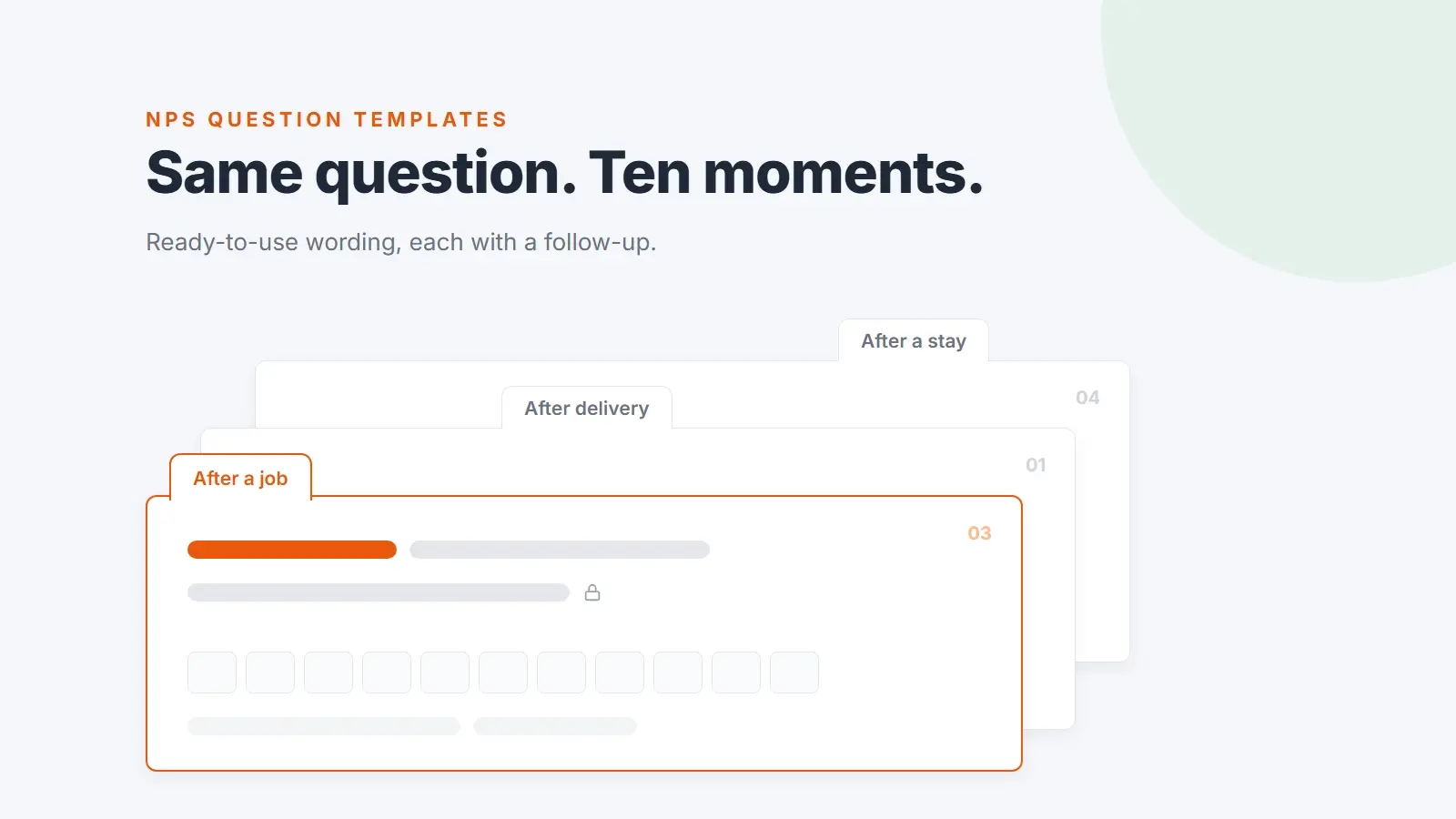
Below are 10 NPS question templates for common situations, from an online order to an agency's quarterly check-in. Each one has the 0 to 10 question, a follow-up open question, and a note on when to use it and why the wording works. Every template keeps the parts of the question that make it an NPS, so your scores stay comparable over time.
If you want the reasoning behind the standard wording, start with the NPS question: exact wording that gets answers. This page is the copy-ready version.
What every template keeps, and what it changes
All 10 templates follow the same rule. They change only two things:
- The name. "Us" becomes your business, store, practice, agency or product. That's standard practice and doesn't affect the metric.
- A short lead-in that names the moment, such as "Now that your order has arrived" or "Thinking about your stay". This is what turns a general question into a transactional one, about a specific experience.
Everything else stays exactly as published by Bain & Company, who own the Net Promoter trademark with Fred Reichheld and NICE:
- "How likely are you to recommend", not "How would you rate" or "Would you recommend".
- "To a friend or colleague", even for a business customer. Changing the audience changes the answers.
- A 0 to 10 scale, labelled only at the ends: 0 is "Not at all likely" and 10 is "Extremely likely".
- No praise inside the question. "Our award-winning team" belongs on your website, not in a survey.
Scores of 9 to 10 are promoters, 7 to 8 passives and 0 to 6 detractors, and your NPS is the percentage of promoters minus the percentage of detractors. Square brackets in the templates are yours to fill in.
Google review reply templates
20 replies you can copy and edit, from a 5-star thank-you to a fair answer to a 1-star complaint. Free, by email.
We'll email the templates from support@dinopix.com.au, then about one email a month with new review guides and Dinopix product news. Unsubscribe in one click from any email. Privacy policy
The 10 NPS question templates
1. Online store, after delivery
Question: Now that your order has arrived, how likely are you to recommend [Store] to a friend or colleague?
Follow-up: What's the main reason for your score? It could be the product, the delivery or anything else.
When and why: Send it a few days after the order is delivered, not at checkout. At checkout the customer can only judge your website; a few days after delivery they can judge what they actually paid for. The lead-in tells them which of those you mean, and the follow-up's examples make it easy to say whether a low score was about the product or the courier.
2. Clinics, salons and other appointments
Question: Thinking about your appointment on [day], how likely are you to recommend [Practice] to a friend or colleague?
Follow-up: What's the main reason for your score? Anything from booking to the appointment itself is useful.
When and why: Send it the same day or the next morning, while the visit is still fresh. Naming the day separates this visit from earlier ones, which matters for regular clients. The follow-up invites comments on booking and waiting, because those are often what people mean when a good appointment still scores a 6. In health settings, people may write about their health in the comment, so limit who on your team can read the answers.
3. Trades, after a job
Question: Now that we've finished the [job] at your place, how likely are you to recommend [Business] to a friend or colleague?
Follow-up: What's the main reason for your score?
When and why: Send it once the job is signed off, as its own message rather than inside the invoice email. A survey that arrives with the bill invites a score about the price. "At your place" and the job name make it personal without leading the answer. For long jobs such as renovations, send one at the end rather than after every stage.
4. Hotels, B&Bs and holiday rentals
Question: Thinking about your stay at [Property], how likely are you to recommend us to a friend or colleague?
Follow-up: What stood out about your stay, good or bad?
When and why: Send it within a day of checkout. "Your stay" points at the experience you control, not the booking site the guest used to find you. "Good or bad" gives a guest permission to mention the one thing that went wrong, which is the comment you most need and the one polite guests leave out.
5. Cafés, restaurants and shops (QR code or receipt)
Question: Based on your visit today, how likely are you to recommend [Business] to a friend or colleague?
Follow-up: What's the main reason for your score?
When and why: For walk-in customers whose email you don't have, put the survey behind a QR code on the receipt, the table or the counter. Keep the follow-up short because people answer on a phone. People who scan choose to answer, which makes them a different group from customers you email, so track QR answers as their own score rather than blending them into your emailed NPS.
6. After a support request
Question: Thinking about your recent [request / enquiry] with our team, how likely are you to recommend [Business] to a friend or colleague?
Follow-up: What's the main reason for your score? If it's about something other than this request, tell us that too.
When and why: Send it when the request is closed, not when it's opened. The question still asks about your business as a whole, seen through this one contact, which is why the follow-up invites comments about other things. A low score with warm words about the person who helped usually means the problem sits further back, in the product or the process that caused the request.
7. Accountants, lawyers and other professional services
Question: Now that your [tax return / matter / project] is complete, how likely are you to recommend [Firm] to a friend or colleague?
Follow-up: What's the main reason for your score?
When and why: Ask when the work is finished, separately from the final invoice, for the same reason as the trades template. "Now that it's complete" stops a client scoring halfway through, when they can't yet judge the result. For clients you work with all year, use the relationship template (number 10) instead.
8. Software and other B2B products
Question: How likely are you to recommend [Product] to a friend or colleague?
Follow-up: What's the main reason for your score?
When and why: Ask people who have used the product long enough to have an opinion, not new signups, because asking too early measures your marketing rather than the product. Survey each user rather than only the account owner, and note their role when you read the results: the person who pays and the person who uses it every day often see the product very differently. Keep "friend or colleague" even though your customer is a business.
9. An agency asking its clients
Question: How likely are you to recommend [Agency] to a friend or colleague?
Follow-up: What's one thing we should start, stop or keep doing?
When and why: Send it on a regular cycle, such as every quarter, rather than straight after a report or a campaign, so one good or bad month doesn't decide the score. Send it to the person you work with day to day and to whoever signs off the budget. With 20 clients answering, each client is 5% of the result, so one client moving from passive to promoter lifts your NPS by 5 points. Read every comment and treat the score as a rough guide. "Start, stop or keep" gets specific answers that a client can give without feeling they're complaining.
10. Relationship NPS, every quarter or six months
Question: How likely are you to recommend [Business] to a friend or colleague?
Follow-up: What's the main reason for your score?
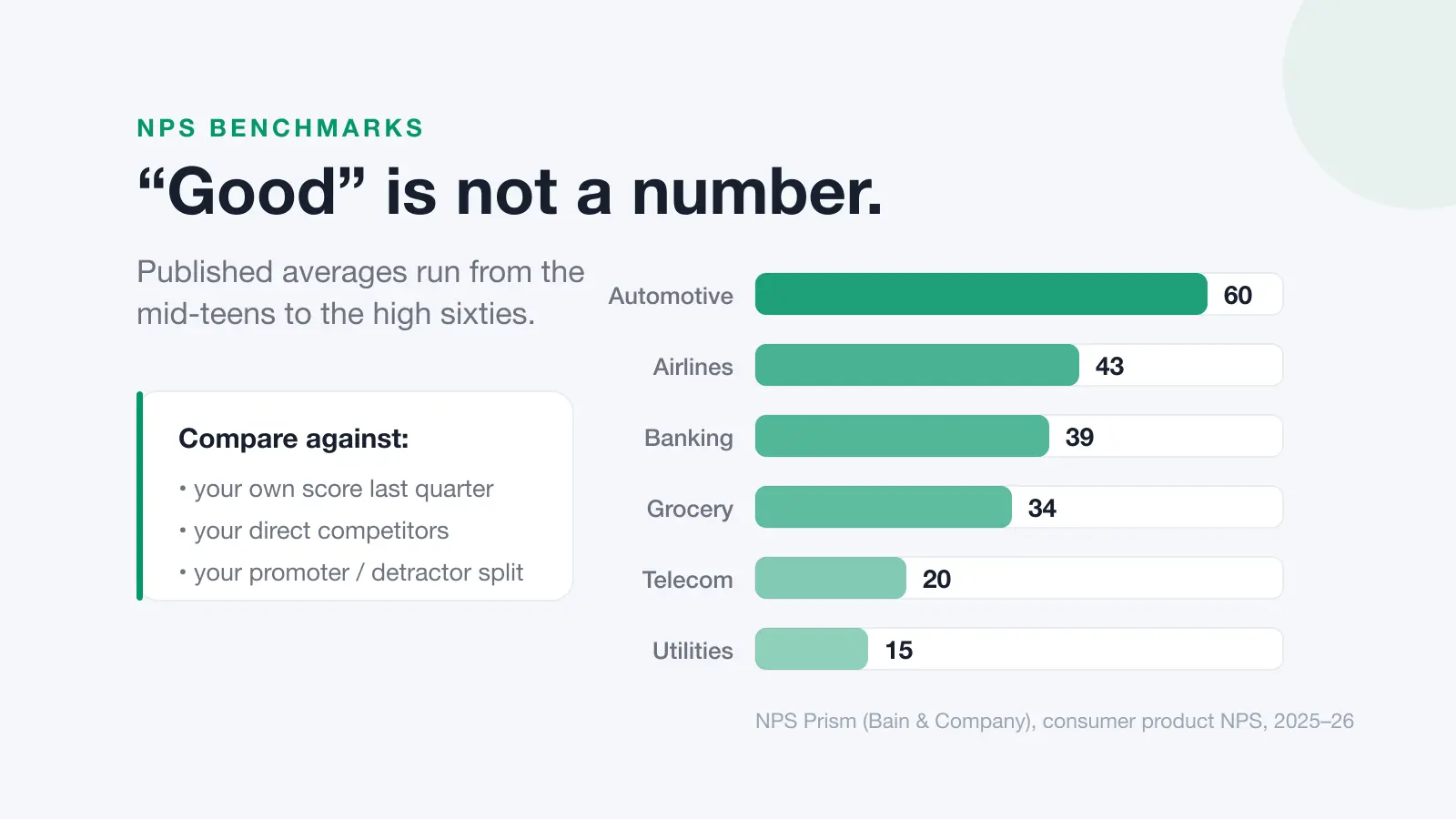
When and why: This is the standard question word for word, sent on a schedule to all your customers rather than after one experience. Use it when you want to compare yourself with published benchmarks such as what a good NPS score looks like in your industry, or to see how customers feel about you overall. Quarterly suits most businesses; every six months suits customers who only buy once or twice a year. Keep it as a separate score from the transactional templates above, because the two give different numbers from the same customers.
If you want a second question by score
One open follow-up is enough for most businesses. If you'd like to ask different people different things, keep it to two versions:
- For scores of 9 to 10: "What did we do well?"
- For scores of 0 to 8: "What would have made this better?"
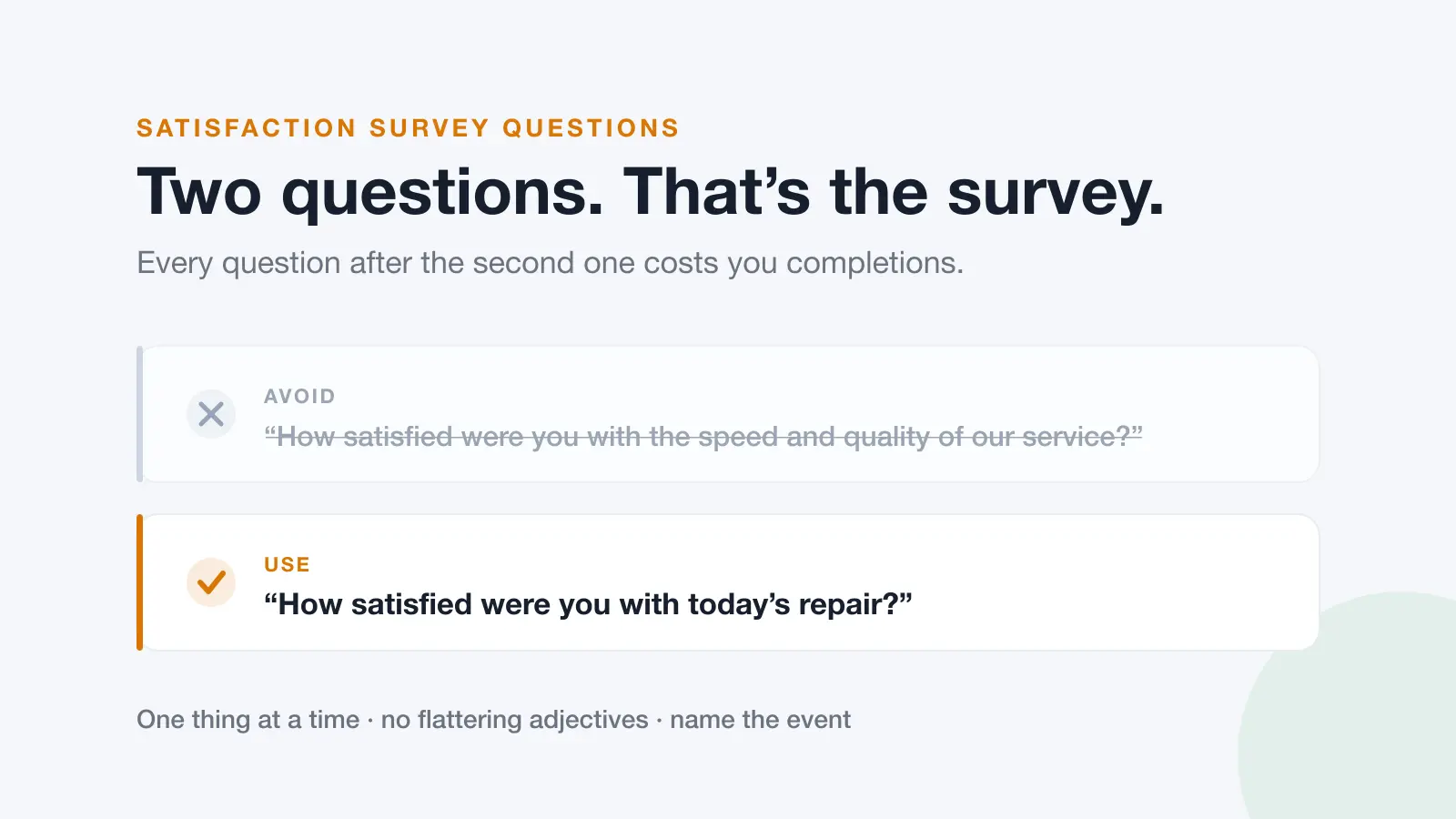
Use these instead of the follow-up in the template, on the same page as the score so a customer doesn't have to click through. Each extra question costs you answers, so only add one you'll act on.
A follow-up question can change with the score. Who you ask for a public review can't. Sending only your 9s and 10s to Google, and steering everyone else to a private form, is review gating. Google's policy for business reviews prohibits businesses from selectively soliciting positive reviews, and Trustpilot's guidelines forbid selective invitations too. Ask everyone the same way, and deal with low scores privately as well.
How to send it
The wording only works if the survey arrives at the right moment and is easy to answer. A few things apply to every template:
- Put the scores in the email. A row of 0 to 10 buttons means answering is one tap, with the follow-up on the page that opens.
- Send it from a name your customer knows. Your business name, or a person's, not a generic no-reply address.
- Keep the email short. The question does the work. Two sentences of introduction is plenty.
- Don't over-survey. Set a limit, such as one survey per person every few weeks, across everything you send.
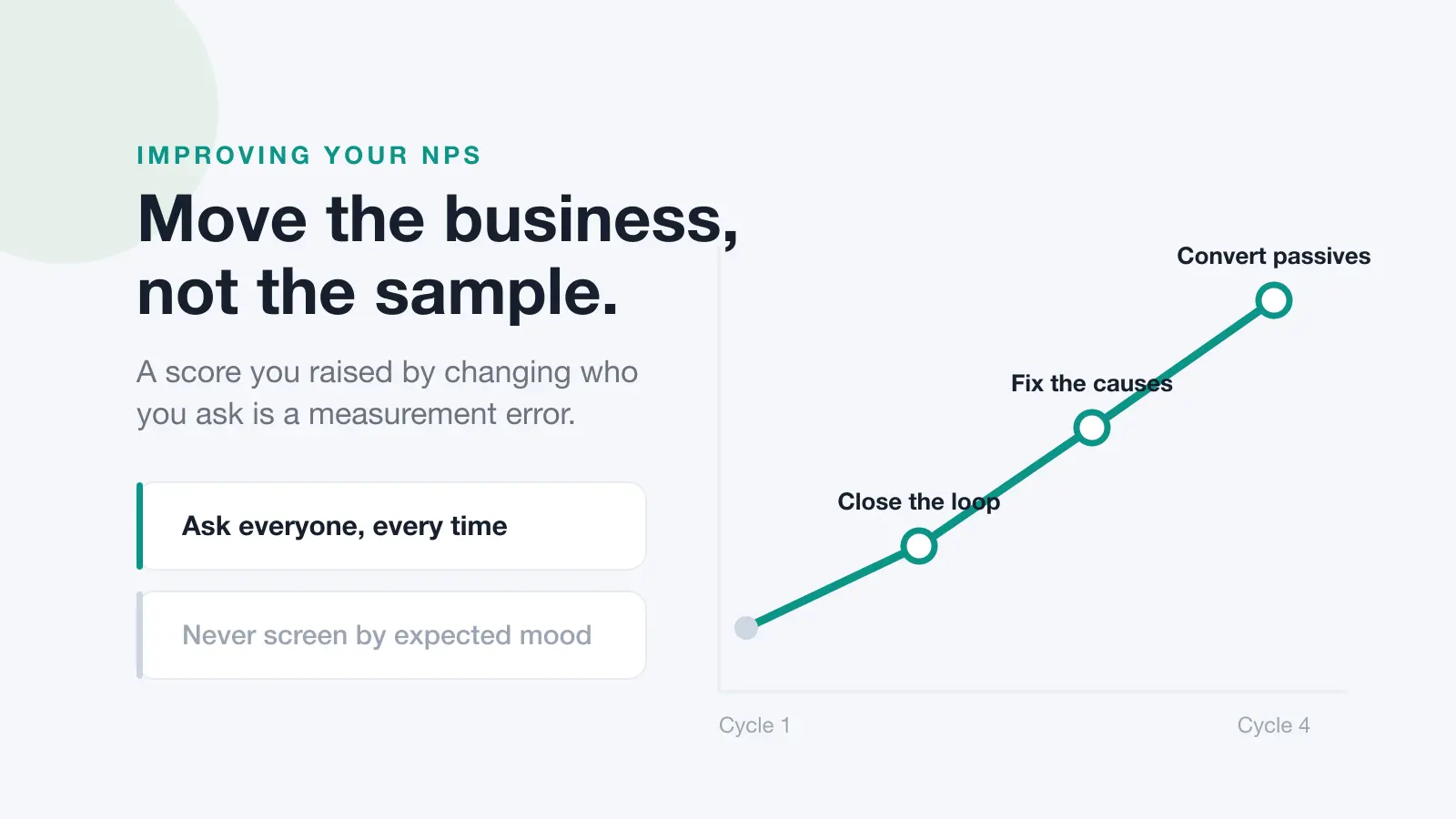
- Reply to detractors. A personal reply within a business day, made privately, does more for that customer than the survey did. Our guide to improving your NPS without gaming it covers what to do with the answers.
A subject line and introduction that work with any of the templates:
Subject: One quick question, [First name]
Hi [First name], thanks for choosing [Business]. We'd love to know how we did. It takes one tap, and if you'd like to tell us more, there's space for that on the next page.
Sending it with Dinopix Surveys
If you'd rather not send surveys by hand, Dinopix Surveys does it for you:
- After delivery, automatically. Every business starts with a Post-purchase NPS survey that asks the standard question, then why. It goes out a set number of days after an order is delivered: fulfilled in Shopify, completed in WooCommerce, or marked delivered in Dinopix. Only orders delivered after you switch it on are surveyed, so past customers aren't emailed in a batch, and nobody gets more than one survey every 14 days.
- Your wording. You can change any survey's subject and message, using
{{first_name}}and{{business_name}}. The 0 to 10 buttons and the unsubscribe link are added for you. With Surveys Pro you can also edit the questions themselves, so any template on this page can be used as written, and ask a question only of certain scores. - The same thank-you for everyone. Everyone who answers sees the same thank-you page with the same link to leave a public review, whatever they scored. Dinopix doesn't offer review gating.
- Low scores become a private follow-up. Turn on follow-up tasks and every score of 0 to 6 becomes a task for the contact's owner. With Surveys Pro, each one also sends an alert and goes into a follow-up inbox where you can reply to the customer.
- Other moments (Surveys Pro). Relationship NPS on a schedule (every 30 to 730 days per person), a link or QR code for your counter with one per location, and a send-only API key so your booking system or till can send a survey when a visit or job is done.
Once the answers come in, the free NPS calculator works out your score from raw 0 to 10 answers or from counts of promoters, passives and detractors. Dinopix also shows your score, response rate and trend for any period you choose.
Frequently asked questions
Can I change the wording of the NPS question?
You can add your business name and a short lead-in that names the experience, such as "Now that your order has arrived". Keep "how likely are you to recommend", "to a friend or colleague" and the 0 to 10 scale. Change those and the result is no longer an NPS, and it can't be compared with your past scores or anyone else's.
What is the best NPS follow-up question?
"What's the main reason for your score?" works for every score, so one survey covers everyone. A short hint after it, such as "It could be the product, the delivery or anything else", helps customers give a specific answer without leading them.
What's the difference between transactional and relationship NPS questions?
A transactional question asks about one experience, soon after it happens: a delivery, an appointment, a finished job. A relationship question asks about your business overall and goes out on a schedule, such as every quarter. They produce different scores from the same customers, so report them separately.
Should a B2B company ask "to a colleague" instead of "to a friend or colleague"?
No. Keep the full wording. Dropping "friend" changes the question and with it the answers, so your score is no longer comparable with standard NPS benchmarks.
Can I ask promoters to leave a review?
You can ask everyone to leave a review, promoters included. What you can't do is ask only promoters, or use the score to decide who sees the review link. That's review gating, which Google's policies and Trustpilot's guidelines both prohibit.
Sources
- Bain & Company, Net Promoter System, Measuring your Net Promoter Score
- Frederick F. Reichheld, The one number you need to grow, Harvard Business Review, December 2003
- Maps User Generated Content Policy Help, Prohibited & restricted content
- Trustpilot, Guidelines for businesses
Google review reply templates
20 replies you can copy and edit, from a 5-star thank-you to a fair answer to a 1-star complaint. Free, by email.
We'll email the templates from support@dinopix.com.au, then about one email a month with new review guides and Dinopix product news. Unsubscribe in one click from any email. Privacy policy