The NPS Question: Exact Wording That Gets Answers

The exact NPS question wording, why the 0-10 scale matters, the follow-up that makes it useful, and the rewrites that quietly invalidate your score.
The Net Promoter Score is built on a single sentence, and most businesses rewrite it. They add a "please", swap "recommend" for "rate", stretch the scale to 1-10, or bolt on three more questions before anyone has answered the first. Each change feels harmless. Together they produce a number that can't be compared with last quarter's, let alone with anyone else's.
This guide covers the exact NPS question wording, why each part of it is the way it is, the follow-up question that does most of the real work, and the mistakes that quietly corrupt the score.
The standard NPS question
The wording published by Bain & Company, who own the Net Promoter trademark alongside Fred Reichheld and NICE, is:
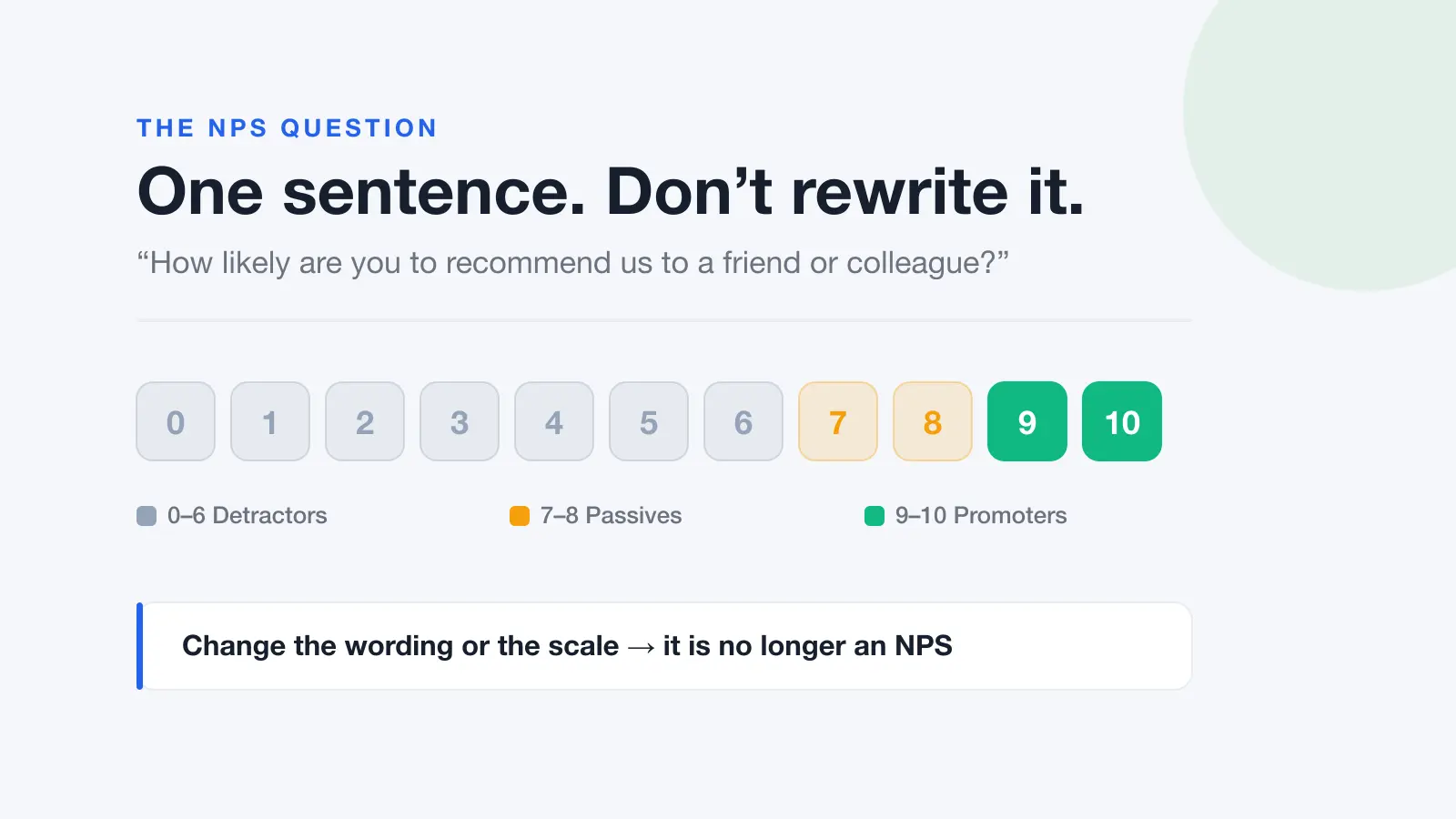
How likely are you to recommend us to a friend or colleague?
Respondents answer on a scale from 0 to 10. Promoters score 9-10, passives 7-8, and detractors 0-6, and the score is the percentage of promoters minus the percentage of detractors.
The question first appeared in Frederick Reichheld's 2003 Harvard Business Review article "The One Number You Need to Grow", whose argument was that companies were measuring the wrong thing, that a single recommendation question predicted growth better than the elaborate satisfaction surveys then in use.
Why each part matters
- "How likely" asks for a prediction of behaviour, not a feeling. That's deliberate: people rate their feelings generously and their intentions more honestly.
- "recommend" puts the respondent's own reputation on the line. Recommending something bad costs them socially, which is what makes the answer discriminating.
- "to a friend or colleague" names a real audience. "To others" is vaguer and produces softer answers.
- The 0-10 scale gives enough range to separate enthusiasm from politeness. A 1-5 scale collapses promoters and passives into the same bucket.
Adapting the question without breaking it
You will need to name what you're asking about. Substituting your business or product for "us" is standard and doesn't compromise the metric:
- How likely are you to recommend [Business] to a friend or colleague?
- How likely are you to recommend [Product] to a friend or colleague?
There are two legitimate variants, and they measure different things. Relationship NPS asks about the business overall and is sent periodically, quarterly for most companies. Transactional NPS asks about a specific experience and is sent immediately after it, worded as "based on your recent [service visit / delivery / support call]".
The follow-up question that does the real work
The score tells you the size of a problem. The open-ended follow-up tells you what it is, and it's the part most businesses either skip or over-engineer.
Ask exactly one, immediately after the rating, and keep it open:
What's the main reason for your score?
That phrasing works for every rating, which matters because a single follow-up question means a single survey and no branching logic. If you do want to branch, keep it to two variants: "What did we do well?" for 9-10 and "What would have made this better?" for 0-8. Anything more elaborate costs you completions.
Wording mistakes that corrupt the score
| Instead of this | Use this | Why |
|---|---|---|
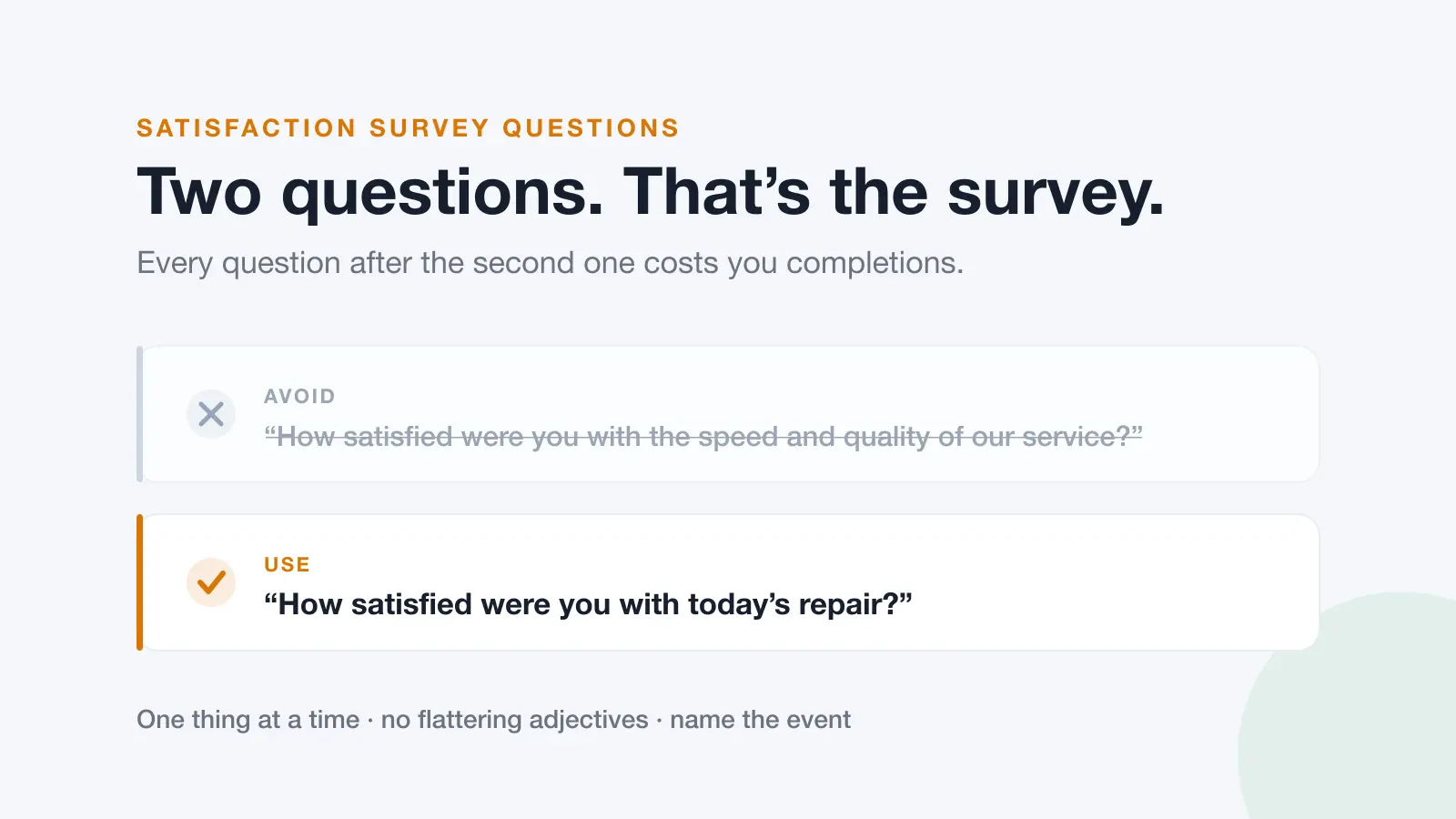
| How would you rate us? | How likely are you to recommend us to a friend or colleague? | Rating measures satisfaction, not advocacy, a different metric entirely |
| Would you recommend us? (Yes/No) | The 0-10 scale | A binary answer can't be split into promoters, passives and detractors |
| On a scale of 1-10… | On a scale of 0-10… | Dropping zero shifts every bucket and makes your score incomparable |
| How likely are you to recommend our excellent service? | How likely are you to recommend us… | Leading wording inflates scores and invalidates the result |
| Please take our 10-question survey | One question, one follow-up | Every extra question lowers completion; NPS is designed to be short |
Three more that catch people out
Labelling the scale badly. Label only the endpoints, 0 as "Not at all likely" and 10 as "Extremely likely". Labelling every point invites people to read the labels instead of the numbers, and the labels never mean the same thing to two respondents.
Asking too early. A recommendation question only makes sense once someone has something to recommend. Sending it at signup, before the customer has used anything, measures your marketing rather than your service.
Translating loosely. If you survey in more than one language, "recommend" and "friend or colleague" need careful translation. A version that reads as "would you advise" produces noticeably different answers.
Ready-to-use templates
Subject: One quick question, [First name]?
Hi [First name], thanks for choosing [Business]. We'd value 10 seconds of your time.
How likely are you to recommend [Business] to a friend or colleague?
[0-10 scale]
What's the main reason for your score? (optional)
SMS
Hi [First name], how likely are you to recommend [Business] to a friend or colleague? Reply 0-10. Thanks! Reply STOP to opt out.
Transactional (after a job or delivery)
Based on your recent [service visit], how likely are you to recommend [Business] to a friend or colleague?
Getting responses at all
The best-worded question in the world does nothing if it lands badly. Send within 24 hours of the experience while it's still specific in the customer's mind, put the rating scale directly in the email body so answering is one click rather than a page load, and send it from a person's name rather than a no-reply address.
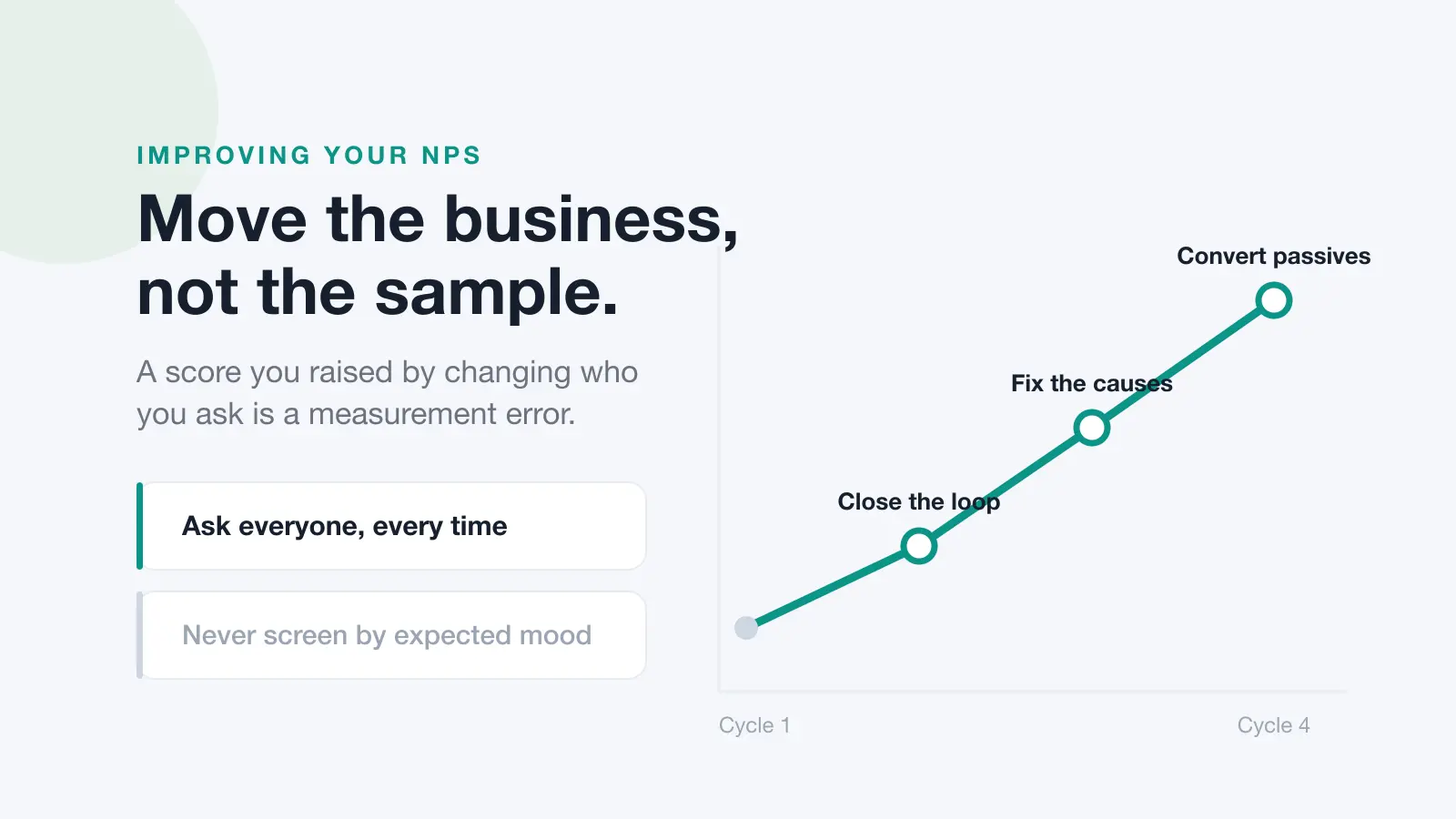
Then close the loop. Reply to every detractor within a business day, and tell the ones who raised a fixable problem when it's fixed. Customers who see a response are measurably more willing to answer the next survey, and a survey nobody answers is worse than no survey, because it produces a confident-looking number from a self-selected few.
If you'd rather not build the sending, chasing and follow-up yourself, that's what Dinopix Reviews handles, automatic requests after each job, every response and public review in one inbox, and AI-drafted replies so closing the loop takes minutes instead of an afternoon.
Frequently Asked Questions
What is the exact NPS question?
"How likely are you to recommend us to a friend or colleague?", answered on a 0-10 scale. Substituting your business or product name for "us" is standard practice. Changing the verb, the audience, or the scale means the result is no longer comparable to a standard NPS.
Should the NPS scale be 0-10 or 1-10?
0-10. The zero is part of the definition, and dropping it shifts every response bucket. Detractors are 0-6, passives 7-8, promoters 9-10. A 1-10 scale produces a different score from identical customers and can't be benchmarked against anyone else's.
Can I ask more than one question in an NPS survey?
One rating question plus one open-ended follow-up is the standard, and it's where the format's high completion rate comes from. Additional questions are possible but each one costs responses, so add them only if you'll act on the answers. If you need a longer survey, run it separately rather than attaching it to your NPS.
What is a good follow-up question for NPS?
"What's the main reason for your score?" is the safest single option, because it works for promoters and detractors alike and needs no branching. If you prefer to branch, use "What did we do well?" for scores of 9-10 and "What would have made this better?" for 0-8, and keep it to those two variants.
How often should I send the NPS question?
For relationship NPS, quarterly suits most businesses, often enough to see movement, rare enough to avoid fatigue. Transactional NPS fires on the event instead, within about 24 hours of the interaction. Whichever you use, cap contact at one survey per customer per period across the whole business.
Does changing the NPS wording invalidate my past scores?
It breaks the comparison, which for most programmes is the same thing. If you do change the wording or the scale, mark the change clearly in your reporting and treat it as the start of a new trend line rather than a continuation of the old one. Don't quietly restate historical scores under the new wording.
Sources
This guide draws on the primary sources below. Definitions and guidance change. Always check the current version.