How to Improve Your NPS Without Gaming It

The three levers that genuinely raise a Net Promoter Score, the shortcuts that only move the number, and why review gating puts your Google listing at risk.
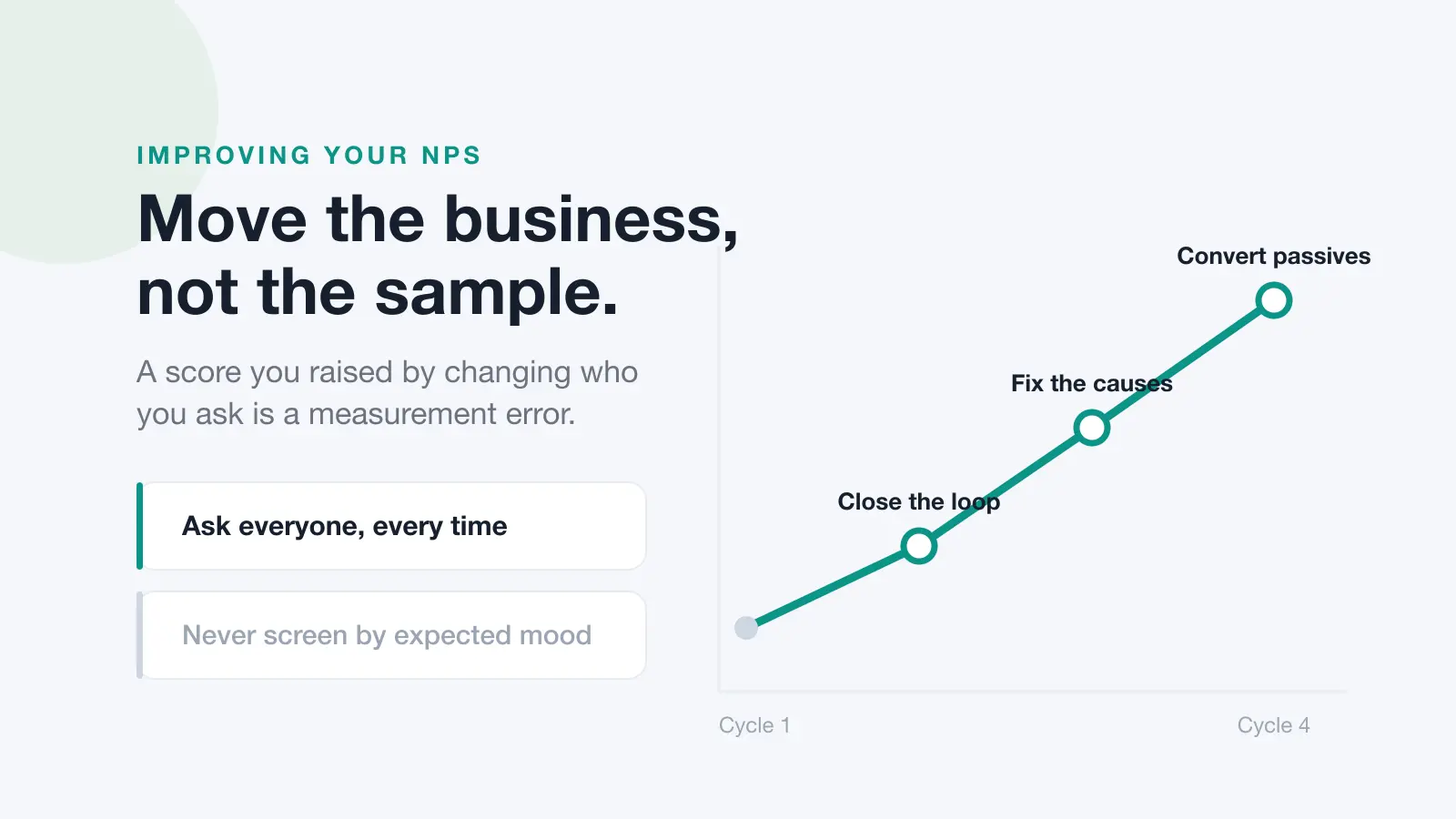
There are two ways to raise a Net Promoter Score. One is to change how customers feel. The other is to change who you ask, when you ask them, and how you phrase it. The second is faster, and it's the reason so many businesses have a rising NPS and a flat revenue line.
This guide covers the levers that genuinely move the score because they moved the business — and the shortcuts that move only the number, some of which will get your Google listing into trouble.
First, check the score is real
Before trying to raise anything, confirm you're measuring something stable. Three checks:
Sample size. NPS is a difference between two percentages, so it's unusually noisy at low volume. With 40 responses, a couple of people changing their answer moves your headline by around five points. Below roughly 30 responses, treat the score as directional only and don't react to movement between periods.
Consistency. Same wording, same 0-10 scale, same audience, same timing, every cycle. If any of those changed, your trend line broke where the change happened and comparisons across it aren't valid.
Who's answering. Compare the profile of your respondents with your customer base. If the people replying skew towards your most engaged customers, your score is measuring your best relationships rather than your business.
The three levers that actually work
1. Close the loop with detractors, fast
This is the single highest-return activity in any NPS programme, and most businesses do it badly or not at all. Every detractor — anyone scoring 0-6 — should hear from a real person within one business day.
The call has one purpose, and it isn't to defend the business. Ask what happened, listen, fix what can be fixed, and tell them what you're changing. Customers who have a problem resolved well frequently end up more loyal than customers who never had one, but only when the response is quick and the fix is real.
Assign ownership explicitly. "The team follows up" means nobody does. One named person per detractor, with a deadline, tracked.
2. Fix the causes, not the incidents
Closing the loop repairs one relationship. Reading across the loop closes the leak. Group your open-text responses into themes monthly — not by sentiment, by cause — and count them. Most businesses find that three or four recurring causes account for the large majority of their detractors.
Then fix one properly rather than four partially. A cause removed stops generating detractors permanently; a cause mitigated generates slightly fewer.
3. Convert your passives
Passives — the 7s and 8s — are excluded from the NPS calculation entirely, which makes them the most efficient group to work on. Moving one passive to a promoter improves your score twice over: it adds to the promoter percentage without you having to fix anything catastrophic.
Passives are rarely angry. They're usually people for whom everything worked and nothing stood out. That means the lever isn't service recovery, it's the small distinguishing thing — the proactive update before they had to chase, the technician who explained rather than just fixed, the follow-up call a week later. Ask your passives what would have made it a 9 and they will generally tell you.
Transactional and relationship NPS pull different levers
Transactional NPS — sent immediately after a specific job — tells you which parts of your operation generate promoters. Use it to find the crew, branch, product line or shift that consistently outperforms, then work out what they do differently and spread it.
Relationship NPS — sent quarterly, asking about the business overall — tells you whether the cumulative effect is working. It moves slowly, and it should. A relationship score that swings ten points between quarters is usually reporting a change in who answered rather than a change in how customers feel.
Run them separately and never blend the responses into one score. They reliably produce different numbers from the same customers, and mixing them creates a trend that moves whenever your send mix changes.
Raise your response rate — carefully
A higher response rate generally makes the score more trustworthy and often makes it lower, because enthusiastic customers answer first and the reluctant middle is less flattering. That's a feature. A score built on 12% of customers that gets worse when you reach 30% of them was never accurate.
The reliable improvements are mechanical: send within 24 hours of the experience, embed the 0-10 scale directly in the email so answering is one click, keep it to the rating plus one open question, and send from a named person rather than a no-reply address. Beyond that, the strongest driver is visibly acting on feedback — customers who saw something change after their last response answer the next one far more readily.
What not to do
Each of these raises the number and damages the business.
| Shortcut | What it really does |
|---|---|
| Surveying only customers you expect to be happy | Removes the detractors from the sample rather than from the business — and gives you a score you can't act on |
| Timing sends to follow good experiences | Measures your best days on repeat; the trend becomes meaningless |
| Asking staff to request a 9 or 10 | Pressures customers, breaches platform policy if it extends to public reviews, and destroys the data |
| Offering a reward for a high score | Conditioning an incentive on a positive rating is prohibited by major platforms and is a consumer-law risk |
| Excluding "unrepresentative" bad responses | Silent data manipulation; the excluded customers are the ones with the information you need |
| Rewording the question when the score dips | Ends the trend line; you now have two unrelated numbers |
A realistic timeline
Closing the loop shows up first, usually within a cycle or two, because recovered detractors stop being detractors. Cause fixes take longer — you need enough new customers to pass through the fixed process before the score reflects it, which for most businesses is two to three cycles. Passive conversion is the slowest and the most durable, because it comes from a change in how you deliver rather than a change in how you recover.
Hold the measurement steady through all of it. The temptation to adjust the survey while waiting is exactly how programmes lose their trend line in the third quarter.
The part of this that scales badly by hand — asking every customer, catching every review, and replying quickly enough for the loop to actually close — is what Dinopix Reviews is built for: automatic requests after each job, every Google and Facebook review in one inbox with sentiment analysed so themes surface on their own, and AI-drafted replies so a same-day response is realistic. For the survey wording itself, see the exact NPS question, and for what your score should be measured against, what counts as a good NPS score.
Frequently Asked Questions
How can I improve my NPS quickly?
The fastest legitimate lever is closing the loop with detractors within one business day — resolving the problem and telling the customer what changed. Recovered detractors often become promoters, and the effect shows in the next cycle. Anything faster than that generally involves changing who you survey rather than what customers experience, which improves the number without improving the business.
Why is my NPS dropping when service has improved?
Usually because your sample changed. Raising your response rate typically lowers your score, since enthusiastic customers answer first and reaching the reluctant middle adds less flattering responses. Check whether your response rate, send timing or survey wording moved at the same time as the score. A drop caused by better coverage is a more accurate score, not a worse business.
Should I focus on detractors or passives?
Both, for different reasons. Detractor recovery protects revenue and stops bad word of mouth, and it's non-negotiable. Passive conversion is where the score moves most efficiently, because passives are excluded from the calculation entirely and usually need a small addition rather than a repair. Most programmes over-invest in detractors and ignore passives completely.
Is it acceptable to ask customers for a high score?
No. Asking for a specific rating pressures the customer, contaminates your own data, and — where it extends to public reviews — breaches the review policies of every major platform. Ask the neutral question and let the answer be what it is. A score you had to request tells you nothing you can use.
How long before improvements show up in the score?
Detractor recovery typically appears within one or two cycles. Fixing an underlying cause takes two to three, because enough customers need to pass through the improved process for the score to reflect it. Changes to how you deliver — the ones that convert passives — are slower still and the most durable. Keep the survey unchanged throughout, or you won't be able to tell what worked.
Can I stop surveying unhappy customers to protect the score?
No, and it's the shortcut most likely to cause real damage. Excluding customers by expected sentiment invalidates the metric, and applying the same logic to public review invitations is review gating — prohibited by Google's review policies and treated as a consumer-law breach in Australia where it inflates a public rating. Survey everyone the same way.
Sources
This guide draws on the primary sources below. Regulations and policies change — always check the current version.
- Measuring Your Net Promoter Score — Bain & Company, Net Promoter System
- Prohibited & restricted content — Google Business Profile Help
- HealthEngine to pay $2.9 million for misleading reviews and patient referrals — ACCC
- FTC announces final rule banning fake reviews and testimonials — Federal Trade Commission, August 2024