Customer Satisfaction Survey Questions That Actually Get Answered

A usable bank of customer satisfaction survey questions by touchpoint, the six rules that make people answer, and the questions worth deleting.
Most customer satisfaction surveys fail before anyone reads a single answer. They're too long, they ask about things the business finds interesting rather than things the customer noticed, and they arrive three weeks after the experience they're asking about.
The fix is rarely a better survey tool. It's fewer, sharper questions, sent sooner, with a genuine plan for what happens to the answers. This guide gives you questions you can use as written, the rules that separate a question people answer from one they abandon, and the ones worth deleting.
Six rules for questions that get answered
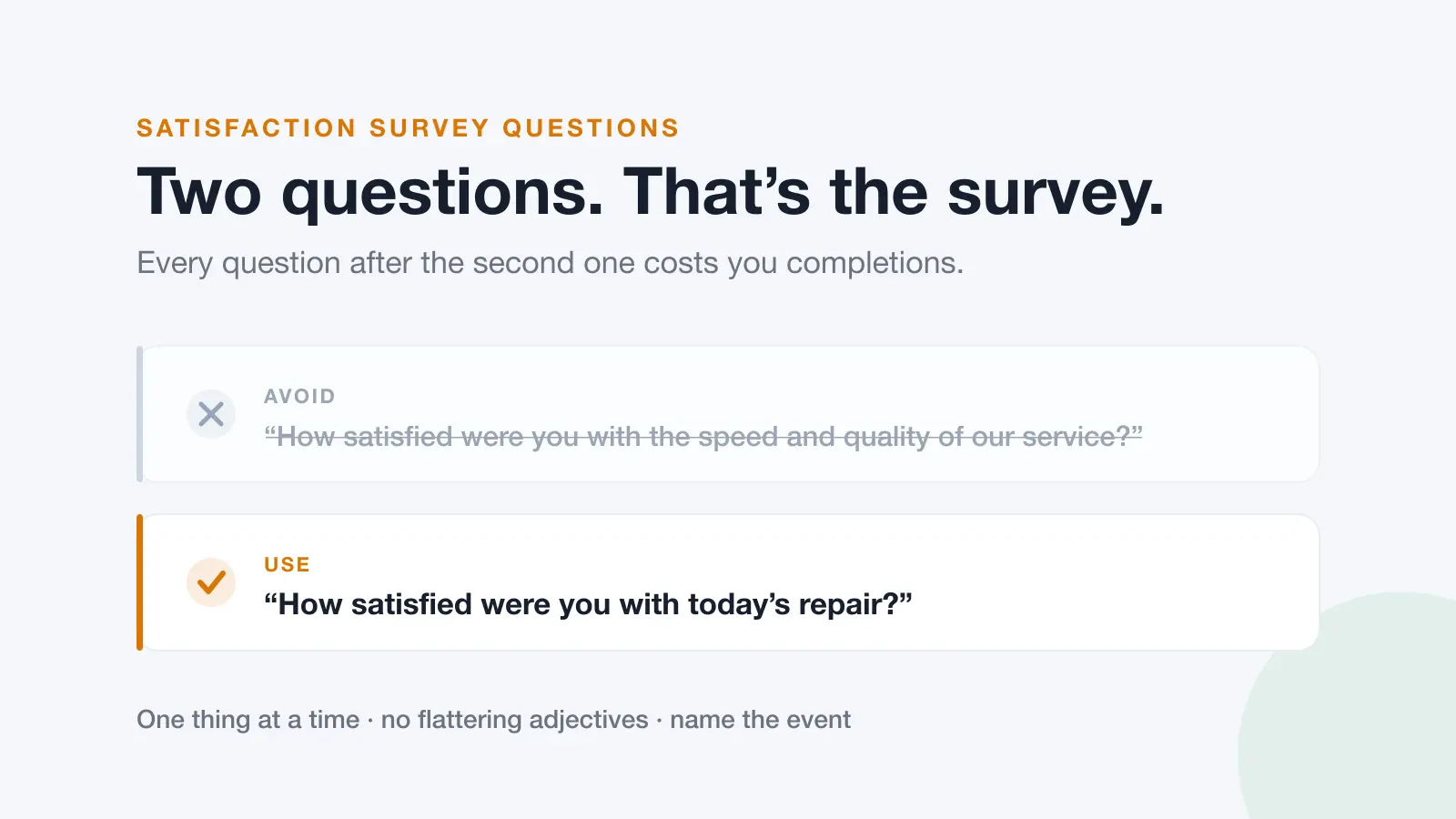
1. Ask about one thing at a time. "How satisfied were you with the speed and quality of our service?" is two questions wearing one coat. A customer who found you fast but sloppy has no honest answer available.
2. Don't lead. "How helpful was our friendly support team?" has already told the respondent the answer. Strip every adjective that flatters you.
3. Be specific about what and when. "How satisfied were you with your recent experience?" invites the customer to average months of interactions into one meaningless number. Name the event: the repair, the delivery, Tuesday's call.
4. Keep the scale consistent. Pick 1-5 for satisfaction and stay there. Mixing 1-5 and 1-7 within a survey confuses respondents, and changing scales between surveys breaks your ability to compare periods at all.
5. Make open questions optional. A required comment box is the most common point of abandonment in a short survey. Optional boxes get fewer comments in percentage terms and more comments in absolute terms, because more people finish.
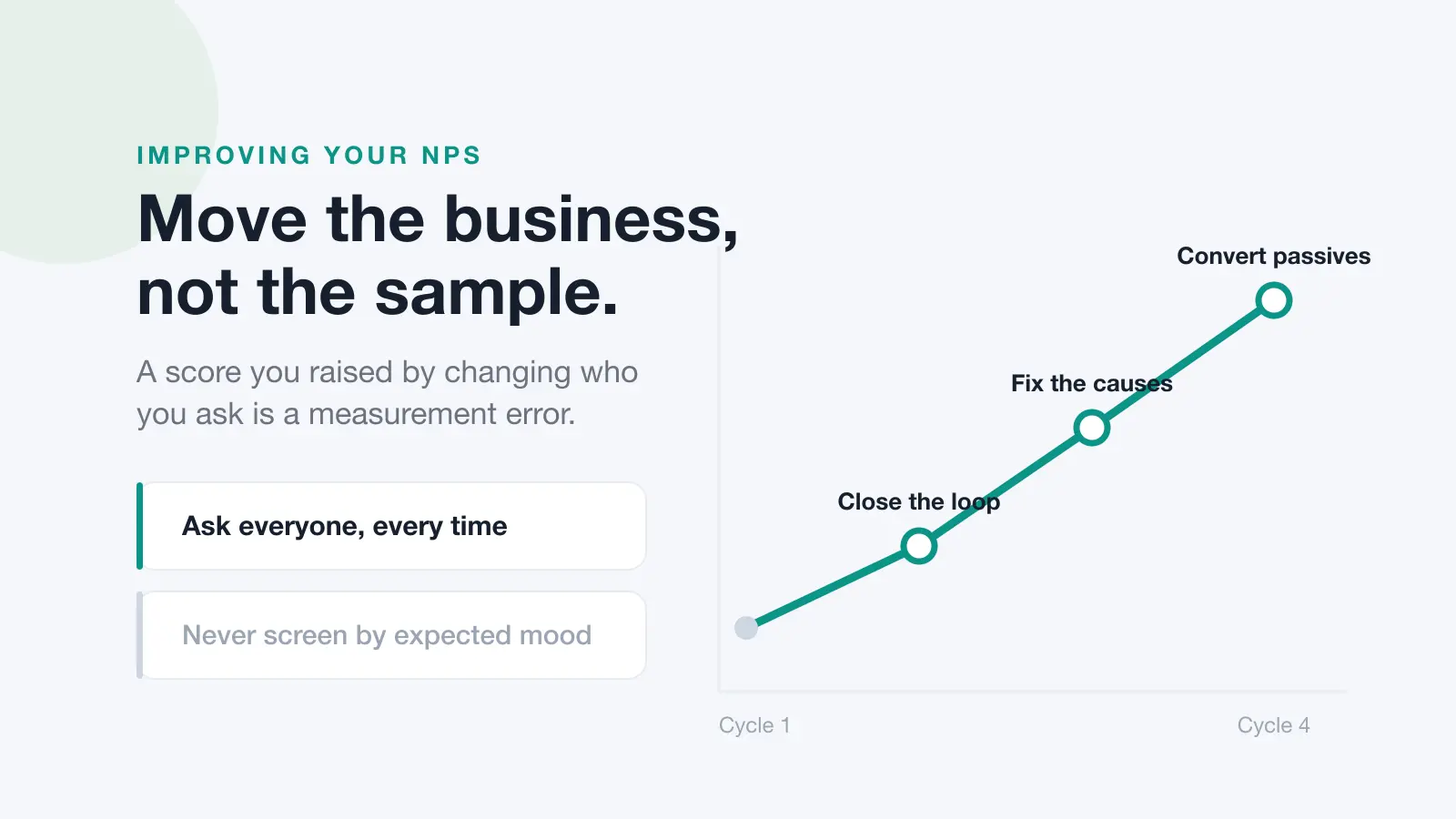
6. Ask only what you'll act on. If no one owns the answer to a question, delete it. Collecting feedback you ignore is worse than not asking — customers notice, and they stop replying.
Question bank: rating questions
Use one of these as your single scored question. Substitute the specific interaction in brackets.
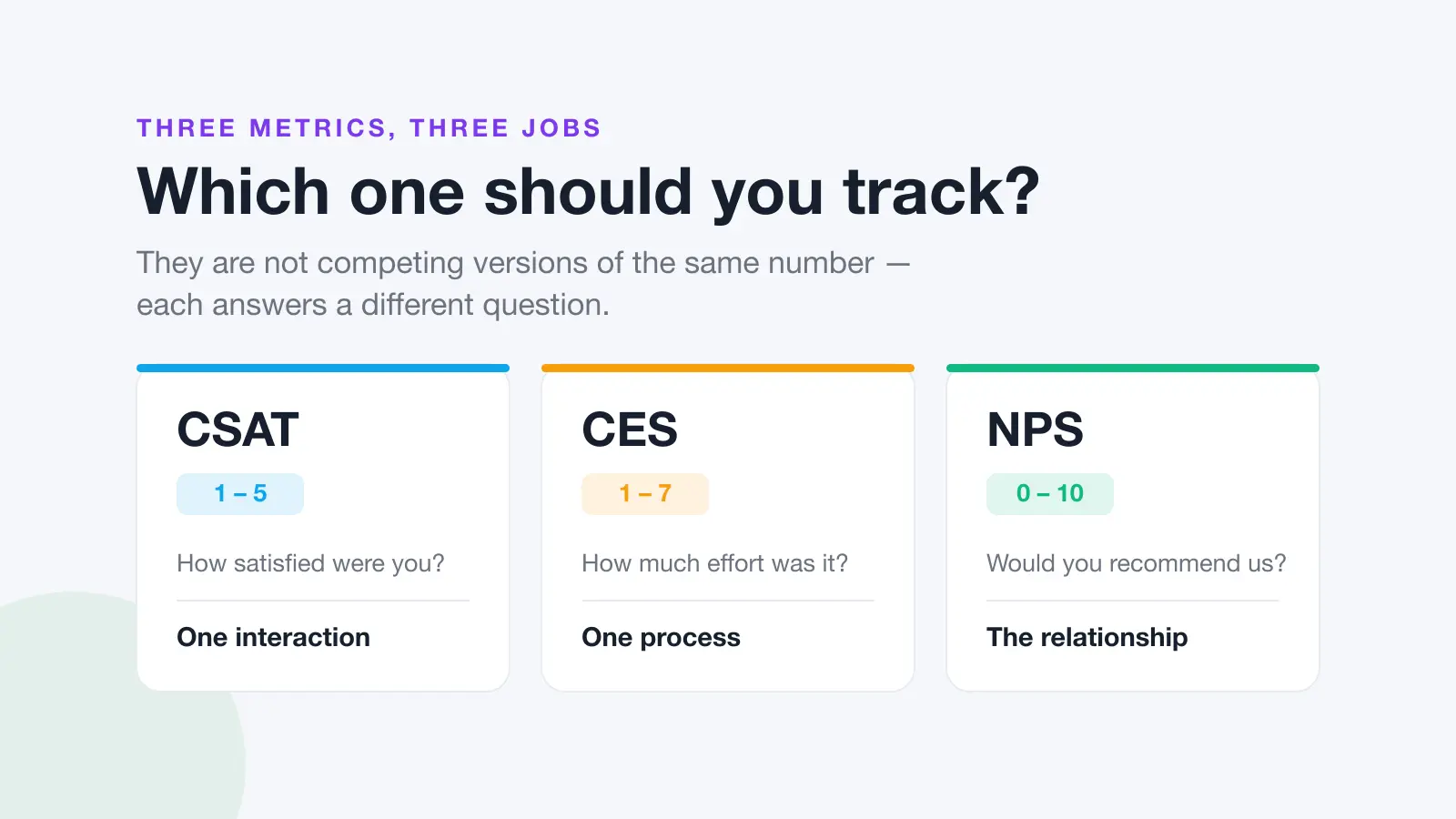
- Interaction satisfaction (CSAT): How satisfied were you with [your recent service visit]? 1 = Very dissatisfied, 5 = Very satisfied
- Effort (CES): [Business] made it easy for me to [resolve my issue]. 1 = Strongly disagree, 7 = Strongly agree
- Recommendation (NPS): How likely are you to recommend [Business] to a friend or colleague? 0-10
- Expectation: Did [the work] meet your expectations? Fell short / Met them / Exceeded them
- Value: How would you rate the value for money of [the service you received]? 1-5
CSAT is reported as the percentage of respondents choosing the top two ratings rather than as an average. The calculation and its pitfalls are covered in how to measure customer satisfaction, and if you're still deciding which of the three scores to run, NPS vs CSAT vs CES compares them directly.
Question bank: open questions
One of these, directly beneath the rating, on the same screen:
- What's the main reason for your score?
- What would have made this a better experience?
- What's the one thing we could do better next time?
- Was there anything about today that didn't go as you expected?
- If you'd recommend us, what would you tell your friend?
Question bank: by touchpoint
| Touchpoint | Rating question | Open question |
|---|---|---|
| After a service job | How satisfied were you with the work carried out today? | What's the one thing we could have done better? |
| After a support ticket | [Business] made it easy for me to resolve my issue. (1-7) | What made it easy or difficult? |
| After a delivery | How satisfied were you with your delivery? | Was there anything about the delivery that didn't go as expected? |
| After onboarding | How confident do you feel using [Product] so far? | What's still unclear? |
| Quarterly relationship | How likely are you to recommend us to a friend or colleague? (0-10) | What's the main reason for your score? |
| After a cancellation | What's the main reason you're leaving? | What could we have done to keep you? |
Questions worth deleting
Some questions appear in almost every survey template and earn their place in almost none.
- "How did you hear about us?" This is an attribution question, not a satisfaction question. It belongs at signup, where the answer is fresh, not in a survey about a service visit.
- Demographic questions. Age and income brackets at the top of a satisfaction survey depress completion and rarely change any decision the business makes.
- "Rate the following twelve aspects of our service." Matrix grids look thorough and are the single biggest driver of abandonment on mobile.
- "Would you like to be contacted?" Contact the people who gave you a low score regardless. Asking permission gives them a way to say no while their problem is still unresolved.
- "Please rate us 5 stars if you were happy." Never. Asking for a specific rating breaches the review policies of every major platform and taints your own data besides.
Timing, length and format
Send within 24 hours of the experience. After a few days, customers are recalling an impression rather than an event, and the specific detail that would have told you what to fix is gone.
Keep it to two questions. Put the rating scale directly in the email body so the first click registers an answer rather than loading a page — a survey that's already half-completed when it opens finishes far more often than one that starts blank.
Send from a person's name and a real reply address. And cap contact centrally at one survey per customer per period across the entire business, or marketing, support and operations will each run their own and all three response rates will fall.
What to do with the answers
Give every question an owner before you launch. Set a threshold that triggers a follow-up — any rating in the bottom two, say — and a deadline for that contact, ideally one business day. Then group the open responses into recurring themes monthly, and fix the theme rather than the individual complaint.
Your public reviews belong in the same pile. They're unprompted, specific, and written for other customers rather than for you, which makes them more candid than most survey text. Reading them alongside your survey comments usually reveals that the two sources are describing the same three problems in different words.
Keeping that side running is what Dinopix Reviews handles — automatic review requests after each job, every Google and Facebook review in one inbox with sentiment analysed so themes surface without manual tagging, and AI-drafted replies so following up takes minutes.
Frequently Asked Questions
What are good customer satisfaction survey questions?
One rating question tied to a specific event — "how satisfied were you with your recent service visit?" on a 1-5 scale — plus one open follow-up such as "what's the one thing we could have done better?". Name the interaction rather than asking about "your experience" in general, avoid adjectives that flatter your business, and ask about only one thing per question.
How many questions should a customer satisfaction survey have?
Two: one scored, one open. Completion rates fall with every additional question, and most surveys collect data nobody acts on. If you genuinely need more, run a separate longer survey with a smaller invited group rather than lengthening the one you send after every interaction.
What scale should I use for a satisfaction question?
A 1-5 scale is standard for CSAT and easy for customers to answer on a phone. Label only the endpoints, keep the same scale across every survey you send, and never change it mid-programme — a 1-5 and a 1-7 scale produce different results from identical customers, so switching breaks comparison with your own history.
When should I send a customer satisfaction survey?
Within 24 hours of the interaction, while the customer still remembers specifics rather than a general impression. Transactional surveys fire on the event; relationship surveys such as NPS run on a fixed cycle, usually quarterly. Cap total contact at one survey per customer per period across the whole business.
How do I increase survey response rates?
Shorten the survey to two questions, embed the rating scale in the email body so answering is a single click, send within a day of the experience, and send from a named person rather than a no-reply address. The larger factor is closing the loop: customers who see that their last piece of feedback led to something are considerably more likely to answer again.
Should I ask customers to leave a review in the same survey?
You can invite every respondent to leave a public review, but never only the happy ones. Filtering the invitation by the score someone gave you is review gating and breaches the review policies of the major platforms. If you're going to ask, ask everyone — and send them to the platform's normal review page rather than pre-selecting a rating for them.
Sources
This guide draws on the primary sources below. Guidance and policies change — always check the current version.