What Is Review Gating, and Is It Illegal?

Review gating means asking only your happy customers for public reviews. Google prohibits it and it can breach consumer law. Here’s why, and the compliant way to collect reviews.
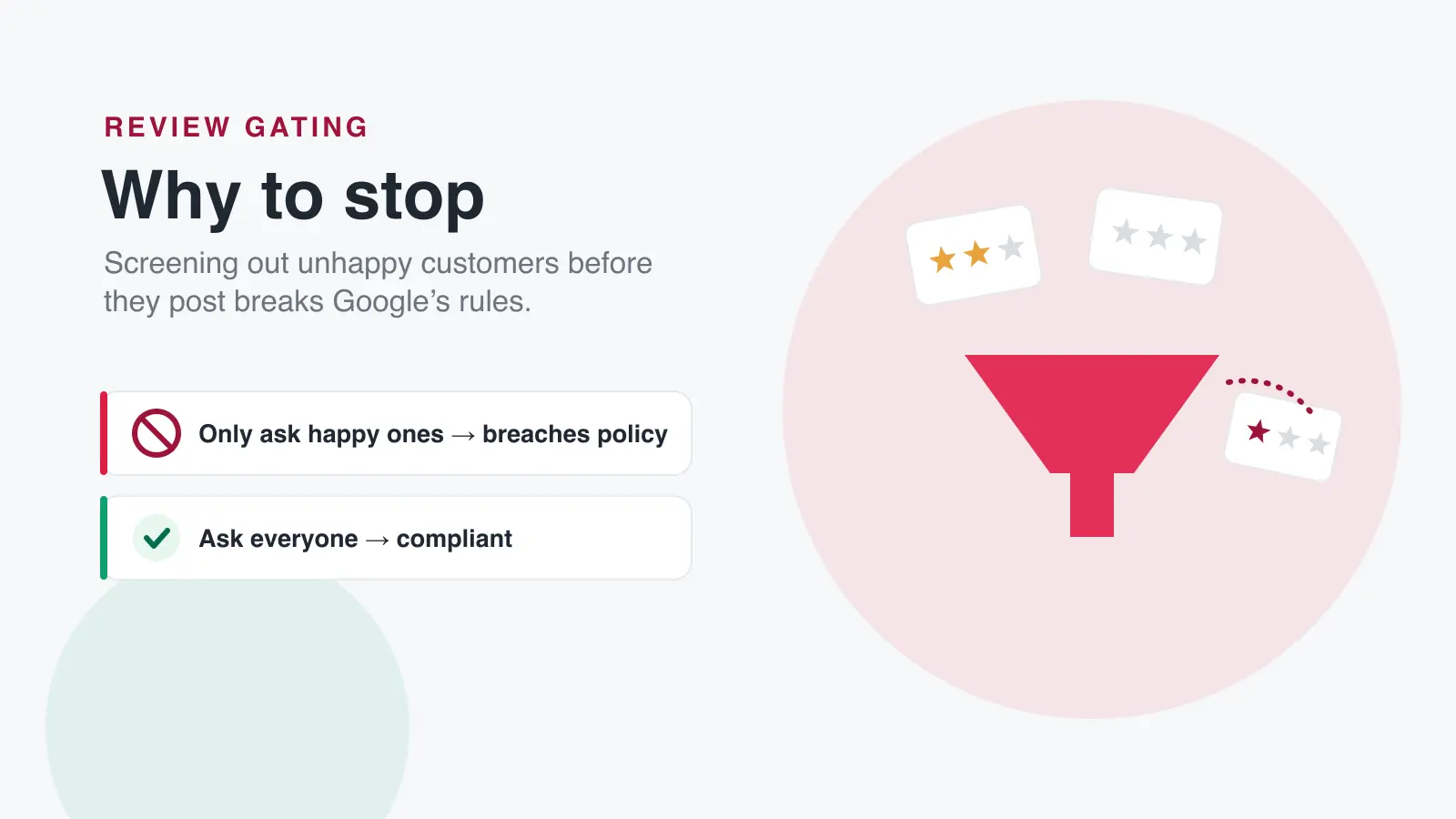
Review gating is the practice of screening customers before asking them for a public review, sending happy customers to Google while diverting unhappy ones to a private feedback form. It's designed to inflate your public rating by filtering out the negatives before they're posted. And it breaches more than Google's policy: in Australia, hiding genuine negative reviews this way can breach the Australian Consumer Law, and in the United States it sits in legally risky territory under the FTC's rules.
Plenty of businesses do it without realising it has a name or that it's prohibited. It's baked into the workflow of some review-request tools. This guide explains what review gating is, why it breaks the rules, how to tell if you're doing it, and how to collect reviews in a way that's both compliant and, as it turns out, better for business.
What review gating actually looks like
Gating usually hides inside a well-meaning process. The classic version works like this:
- After a purchase, the customer is asked a screening question. Often "How was your experience?" or a 1–5 star tap.
- Customers who respond positively are routed to your public Google review page.
- Customers who respond negatively are routed to a private form that goes to you, not to Google.
The result is a public profile that only ever hears from satisfied customers. It looks like great service; it's actually a filter. The negative experiences still happened. They've just been quietly intercepted before they could become public.
Softer versions count too: only emailing review requests to customers you know were happy, or asking for a Google review out loud only when a visit went well. If the deciding factor in whether you ask for a public review is how positive you expect it to be, that's gating.
Why it breaks the rules
Three separate authorities take a view, and they've converged.
Google's policy has long prohibited "biased review solicitation." Merchants aren't allowed to discourage negative reviews or selectively solicit positive ones. Gating breaches this directly, and Google can suspend reviews or restrict a profile over it.
The ACCC in Australia is the clearest. Selectively hiding genuine negative reviews to inflate your rating breaches the Australian Consumer Law, the ACCC fined HealthEngine $2.9 million partly for failing to publish a large volume of negative reviews. Diverting unhappy customers to a private form so their honest feedback never appears publicly is the same idea: presenting a misleadingly positive picture.
The US FTC has not banned survey-style gating by name, but its 2024 Consumer Reviews and Testimonials Rule bans two closely related practices: conditioning an incentive on a review being positive, and suppressing reviews through unfounded legal threats or intimidation. Selectively soliciting only positive reviews can also be a deceptive practice under the FTC Act more broadly. In short: gating is legally risky in the US, even though the rule does not name it.
Why gating backfires even when nobody catches you
Set the law aside for a moment, because gating is a bad idea on its own terms.
A flawless rating is a red flag. Consumers have learned to distrust a wall of 5-star reviews. A profile with a handful of thoughtful negatives and a strong overall average reads as more credible than a suspiciously perfect one, and shoppers often read the negative reviews first specifically to see how a business responds.
You lose the feedback that fixes the business. Gating routes your unhappy customers into a private form you may or may not act on, and denies you the public accountability that drives real improvement. The complaints don't disappear; they resurface on other platforms, in word of mouth, and in churn.
It's fragile. A single screenshot of your screening flow, shared publicly, is a reputational problem for a business that sells trust. The downside is asymmetric: modest gains in average rating, against the risk of being seen to rig it.
How to collect reviews the compliant way
The compliant method is simpler than gating, not harder:
- Ask every customer, not a hand-picked subset. Send the same request to everyone after a purchase or job.
- Send them all to the same place, your public review page, regardless of how you expect them to feel.
- Don't offer incentives for reviews, and never condition anything on the review being positive.
- Make it easy, a direct link or QR code to your Google review page, sent promptly while the experience is fresh.
- Respond to what comes back, especially the negatives. That's where trust is actually built.
Done consistently, asking everyone produces a rating that's higher and credible, because the volume of genuine positive experiences naturally outweighs the occasional bad one, no filtering required. This is exactly what a compliant review platform automates: Dinopix Reviews sends the same request to every customer, routes everyone to your real review page, and surfaces each new review so you can respond, building your rating the way Google, the FTC and the ACCC all intend, and the way customers actually trust.
Frequently Asked Questions
Is review gating illegal everywhere?
It's prohibited by Google's policy everywhere Google operates. In Australia, hiding genuine negative reviews to inflate your rating can breach the Australian Consumer Law. In the United States, the FTC's rule doesn't name survey-style gating, but it bans closely related practices and selectively soliciting only positive reviews can be deceptive under the FTC Act. The safe assumption is that it's not worth the risk anywhere.
Is it gating if I just ask my happy customers in person?
Yes, in substance. If the reason you ask a particular customer for a public review is that you expect them to be positive, you're selectively soliciting, which is what the rules prohibit. Ask all customers, or none; don't let expected sentiment decide who gets asked.
Can I still collect private feedback separately?
Yes. You can gather private feedback through surveys or forms, and it's good practice. The line is crossed when private feedback is used to divert unhappy customers away from leaving a public review they otherwise would have left. Offer private feedback to everyone, not only to those you're steering away from Google.
What's the difference between review gating and just asking for reviews?
Asking for reviews means inviting all your customers to share their honest experience publicly. Review gating means filtering who gets that invitation based on how positive you expect them to be. The first is encouraged; the second is prohibited. The test is whether every customer gets the same ask.
My review software routes ratings automatically, am I liable?
Potentially yes. Using a tool that sends positive responders to Google and negative ones to a private form is review gating regardless of who configured it, and the liability sits with your business. Review what your tool does and switch off any conditional routing that filters by expected sentiment.
Will asking unhappy customers for reviews tank my rating?
Rarely, if you ask everyone consistently. Most customers are satisfied, so a steady stream of requests to all of them produces far more positives than negatives, lifting your average through volume. It also gives you the chance to respond publicly to criticism, which prospective customers weigh heavily, rather than hiding it.
Sources
This guide draws on the primary sources below. Regulations change. Always check the current version.