What Is Customer Advocacy?

What customer advocacy means, how it differs from satisfaction and loyalty, how to build it, and how to measure it with behaviour rather than sentiment.
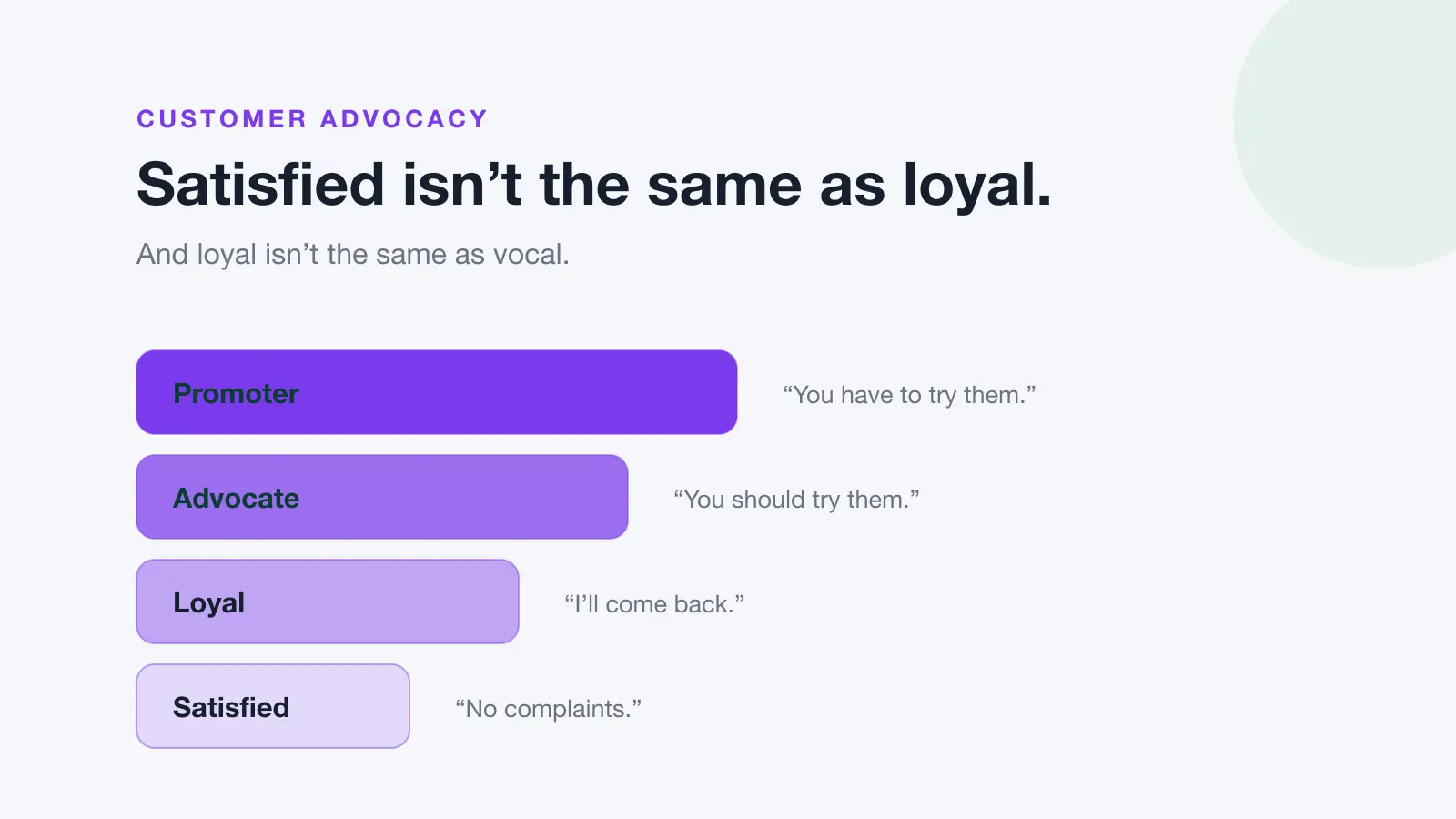
Customer advocacy is what happens when a satisfied customer becomes an active promoter — recommending you unprompted, defending you when someone criticises you, and bringing other people with them. It's the point at which your customers start doing your marketing, and it's a meaningfully different state from satisfaction.
The term has two meanings
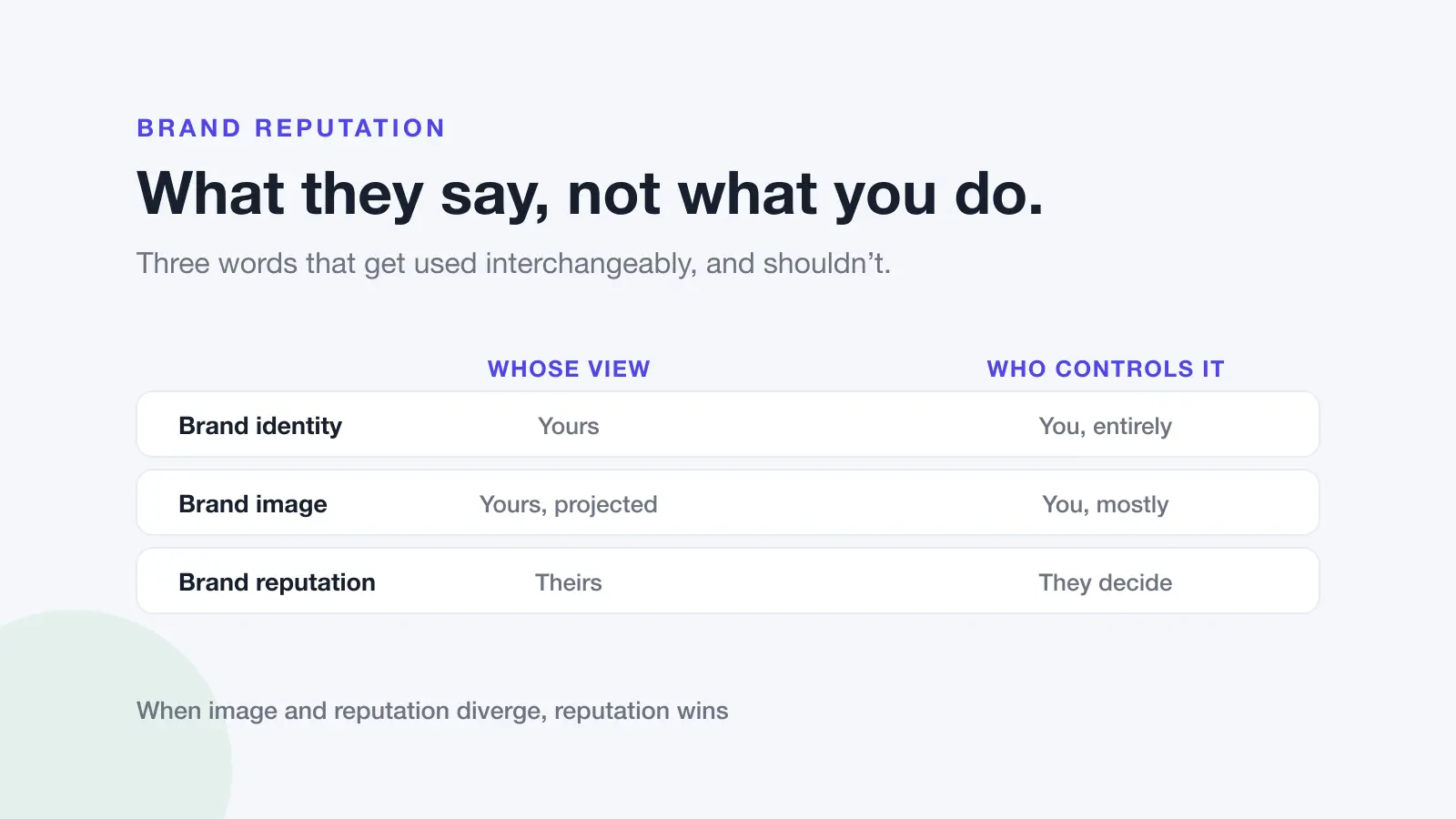
Confusingly, "customer advocacy" is used for two different things, and people talk past each other constantly.
Customers advocating for you. Customers actively recommending your business — reviews, referrals, defending you in a community. This is the sense used in marketing, and the sense used here.
You advocating for the customer. An internal stance where staff represent the customer's interest inside the business — someone in the room asking whether a decision is actually good for customers. This is the sense used in service and product teams.
They're related: the second reliably produces the first. A business that genuinely acts in customers' interests earns advocates; one that merely satisfies them gets indifference.
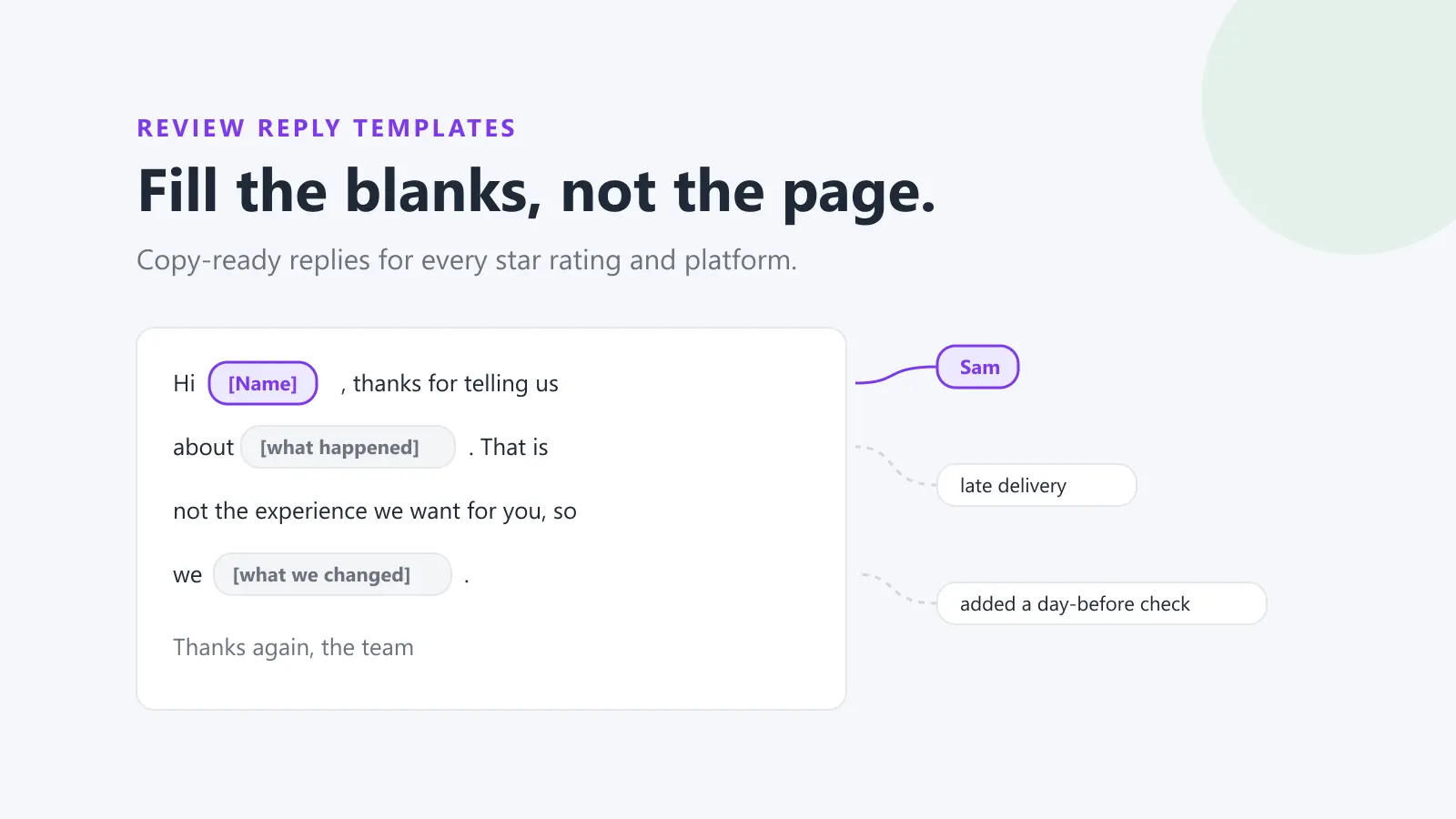
Google review reply templates
20 replies you can copy and edit, from a 5-star thank-you to a fair answer to a 1-star complaint. Free, by email.
We'll email the templates from support@dinopix.com.au, then about one email a month with new review guides and Dinopix product news. Unsubscribe in one click from any email. Privacy policy
The ladder
Customers move through recognisable stages, and each one needs something different from you.
| Stage | What they think | What they do | What moves them up |
|---|---|---|---|
| Satisfied | "No complaints." | Nothing | Something memorable, not just adequate |
| Loyal | "I'll use them again." | Comes back | Being recognised and remembered |
| Advocate | "You should use them." | Recommends when asked | Being asked, at the right moment |
| Active promoter | "You have to use them." | Recommends unprompted; defends you | Feeling a stake in your success |
Why it matters commercially
A recommendation carries weight that advertising can't buy, because the person making it is risking their own credibility. That's the mechanism: a friend's recommendation is trusted precisely because it costs them something if you're bad.
Advocacy also compounds. Advocates bring customers who arrive pre-trusting, spend less time price-shopping, and are themselves more likely to become advocates. A steady stream of recommendations is one of the few marketing assets that gets cheaper as it grows.
How to build it
Fix the recurring problems first. Nobody advocates for a business they have to make excuses for. Advocacy work on top of an unresolved operational problem is wasted.
Give people something specific to say. "They were fine" isn't a recommendation. Doing one thing distinctly better — arriving when you said, explaining without jargon, following up unprompted — gives an advocate a concrete sentence.
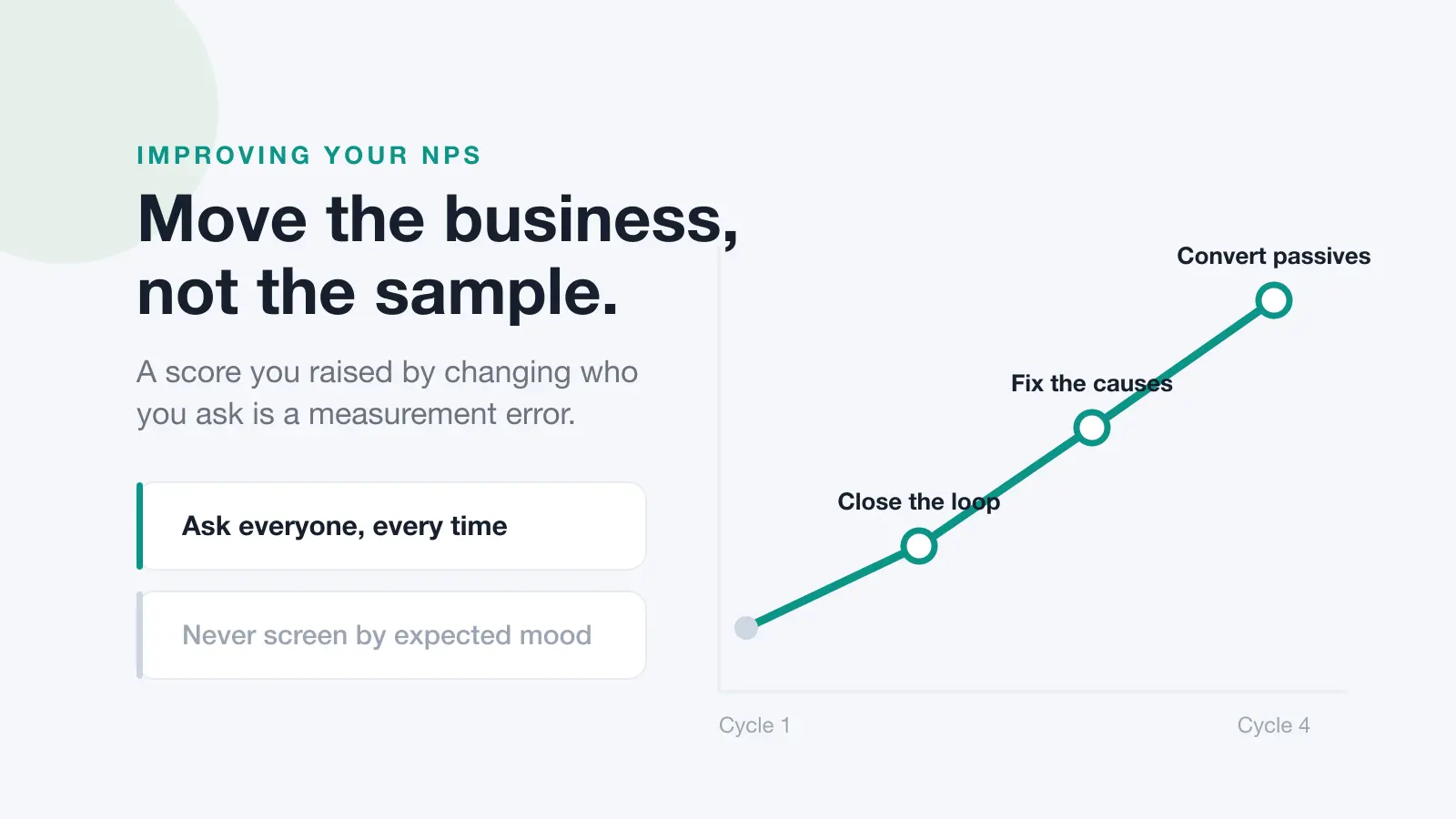
Ask. The largest single source of untapped advocacy is customers who were never asked to leave a review or make an introduction. Ask everyone, ask soon, and never offer anything in exchange — incentivised reviews breach platform policies, and paying for advocacy converts it into advertising, which is exactly the trust the recommendation was carrying.
Close the loop. Customers who raise a problem and see it fixed become advocates at a notably higher rate than customers who never had a problem. Recovery is an advocacy engine, not just damage control.
Reply in public. Every reply to a review is read by other customers. Consistent, human responses signal that recommending you is safe.
Measuring it
Advocacy is behavioural, so measure behaviour rather than sentiment:
- Review volume and recency — the most direct public evidence, and the easiest to influence.
- Referral share — what proportion of new customers arrived through an existing one.
- Repeat and retention rates — advocacy without loyalty is rare.
- Unprompted mentions — social posts and community recommendations you didn't ask for.
Survey metrics have a role too. NPS was designed around exactly this question — how likely someone is to recommend you — though it measures stated intention rather than action. If you're choosing a measure, see NPS vs CSAT vs CES.
The mechanical part — asking every customer at the right moment, catching every review, replying while it still matters — is what Dinopix Reviews automates, so advocacy stops depending on someone remembering to ask.
Frequently Asked Questions
What is customer advocacy?
Customer advocacy is when customers actively promote your business — recommending you to others, leaving reviews, and defending you publicly. It goes beyond satisfaction, which only means the absence of complaints, and beyond loyalty, which means they return themselves. An advocate is willing to put their own credibility behind you.
What's the difference between customer advocacy and customer loyalty?
Loyalty is about the customer's own behaviour — they keep coming back. Advocacy is about their influence on others — they bring people with them. The two usually travel together but not always: plenty of businesses have loyal customers who have never recommended them to anyone, generally because nobody ever asked.
How do you measure customer advocacy?
Measure behaviour rather than sentiment: review volume and recency, the share of new customers arriving by referral, repeat purchase rates, and unprompted mentions online. NPS is the standard survey measure because it asks directly about likelihood to recommend, but it captures stated intention rather than what customers actually did.
Can you pay customers to advocate for you?
No — not for reviews or public endorsements. Incentivised reviews breach the policies of every major review platform, and the FTC's 2024 rule prohibits conditioning an incentive on the sentiment of a review. Beyond the compliance problem, payment removes the credibility risk that made the recommendation persuasive in the first place.
What is a customer advocacy programme?
A structured effort to identify satisfied customers and make it easy for them to recommend you — typically combining a consistent review request after every job, a referral route that doesn't require a public endorsement in exchange for a reward, and reliable follow-up when customers do raise issues. The core is consistency rather than any single tactic.
Does resolving complaints create advocates?
Frequently, yes. Customers whose problems are resolved quickly and well often become stronger advocates than customers who never encountered a problem, because they have direct evidence of how the business behaves under pressure — which is exactly what a recommendation is meant to vouch for.
Sources
This guide draws on the primary sources below. Regulations and policies change — always check the current version.
Google review reply templates
20 replies you can copy and edit, from a 5-star thank-you to a fair answer to a 1-star complaint. Free, by email.
We'll email the templates from support@dinopix.com.au, then about one email a month with new review guides and Dinopix product news. Unsubscribe in one click from any email. Privacy policy