How to Ask for Google Reviews Without Breaking the Rules

How to ask customers for Google reviews so they actually respond, and exactly where the line sits between asking well and review gating.
Most businesses have far more goodwill than reviews. The customers are happy; nobody asked them. Asking is the single highest-return activity in review management, and it's also where businesses most often stray into practices that breach Google's policies without realising it.
This covers how to ask for Google reviews so that customers actually respond, and where the line sits between asking well and gating.
The rules first
Google permits asking customers for reviews. It's an explicitly acceptable practice. What it prohibits is narrower and specific:
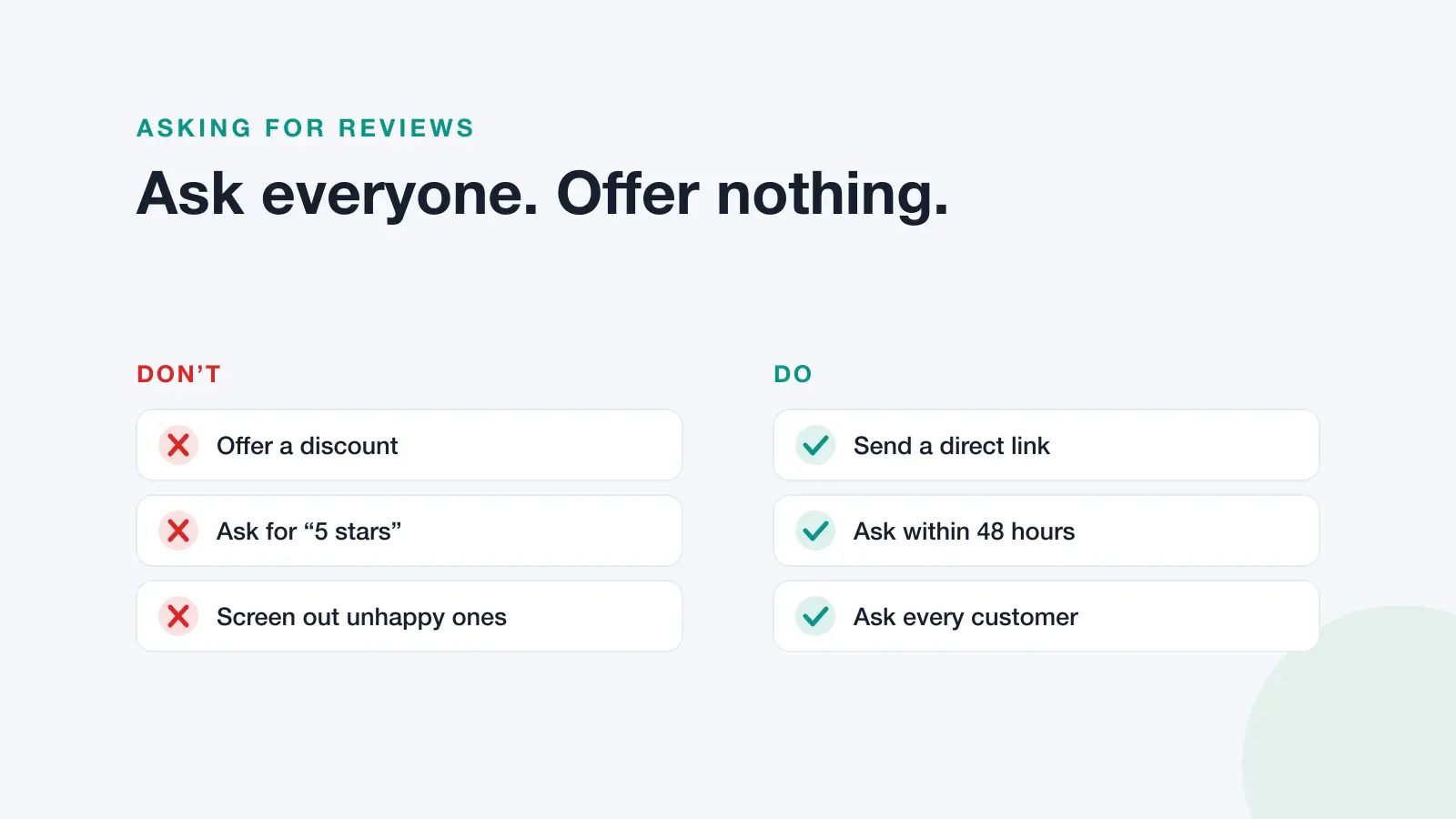
- No incentives. You cannot offer discounts, free products, entry to a prize draw, or anything else in exchange for a review — positive or otherwise.
- No selective asking. Soliciting reviews only from customers you expect to be happy, or routing unhappy ones to a private feedback form instead, is review gating and breaches Google's policies.
- No review stations. Setting up a device in your premises for customers to leave reviews on the spot risks having those reviews filtered — many will come from the same IP address, which looks like fake engagement.
- No buying or trading. Paying for reviews, or swapping them with another business, is prohibited and detectable.
When to ask
Timing does more for your response rate than wording does. Ask while the experience is still specific in the customer's mind — same day is ideal, within 48 hours is fine, and a fortnight later is largely wasted.
The best moment is immediately after a visible success: the repair works, the delivery arrives intact, the problem gets solved. If your business has a natural "and we're done" moment, that's your trigger.
How to ask
Use a direct review link
Google provides a link that opens the review box with your business already selected. Send that, not your website, and not "find us on Google". You can get it from your Business Profile, and it can also be turned into a QR code for receipts, cards and signage.
Ask in the channel you already use
If you text customers about appointments, text the request. If everything runs through email, email it. Adding a new channel purely to request reviews reliably underperforms using an established one.
Keep the message short
Three lines is plenty: thank them, say why reviews help, give the link. Length reads as effort being asked of the customer.
"Thanks again for choosing [Business], [Name]. If you have a moment, a quick Google review really helps other local people find us — it takes about a minute: [link]. Thanks! — [Your name]"
Ask in person, then follow up in writing
A face-to-face ask sets the expectation; the message provides the mechanism. Neither works nearly as well alone.
What to avoid saying
| Don't say | Say instead | Why |
|---|---|---|
| "Leave us a 5-star review" | "Leave us a review" | Asking for a specific rating breaches policy and taints the review |
| "Review us and get 10% off" | "If you have a moment…" | Incentivised reviews are prohibited outright |
| "If you were happy, review us here — if not, reply to this email" | One link, sent to everyone | That's review gating |
| "Please tell us we did a good job" | "Tell other customers what your experience was like" | Leading the content is a policy risk |
| Asking again, and again | One ask, one reminder at most | Repeated requests annoy customers and rarely convert |
What to do about the unhappy ones
The instinct behind gating isn't unreasonable — nobody wants to invite a one-star review. The legitimate version of that instinct is to fix the problem before you ask, not to filter who you ask.
If a job went badly, resolve it. Call, apologise, put it right, and then send the same review request you send everyone else. Customers whose problems were fixed well often write the most persuasive reviews you'll get, precisely because they describe something going wrong and being handled.
Making it consistent
The reason most review programmes fade is that asking depends on someone remembering, at the end of a busy day, to send a message. It survives about three weeks.
The fix is to make the request automatic and attached to the job rather than to a person's memory — every customer, same message, same timing, sent whether or not anyone is thinking about it. That's what Dinopix Reviews does, along with collecting the resulting reviews from Google and Facebook into one inbox so replying is as easy as asking.
For the customer's side of the process — useful if you want to know exactly what you're sending people into — see how to leave a Google review.
Frequently Asked Questions
Is it against Google's rules to ask for reviews?
No — asking customers for reviews is permitted. What Google prohibits is offering incentives in exchange for reviews, asking for a specific star rating, and selectively soliciting reviews only from customers you expect to be positive. Ask everyone, ask neutrally, and offer nothing in return.
Can I offer a discount for leaving a Google review?
No. Google prohibits incentivised reviews, and in the United States the FTC's 2024 rule on consumer reviews prohibits conditioning an incentive on the sentiment of a review. Reviews obtained this way are liable to be removed, and the practice creates legal exposure well beyond the review itself.
How soon after a purchase should I ask for a review?
Same day where possible, and within about 48 hours otherwise. The specific detail that makes a review useful fades quickly, and response rates fall sharply after the first few days. For businesses where the outcome takes time to become apparent, ask once the customer can actually judge the result.
How many times can I ask the same customer?
Once, with at most one reminder a few days later. Beyond that you're eroding the relationship for a review you probably weren't going to get. If a customer hasn't responded to two messages, treat that as their answer and don't include them in future requests.
Can I ask customers to review us on a tablet in the shop?
It's a bad idea. Multiple reviews originating from the same device and IP address in quick succession is a pattern Google's fake-engagement systems look for, and the reviews are liable to be filtered out. Send customers a link to use on their own device instead.
What if asking everyone gets me negative reviews?
Some of them will be, and that's the system working. A profile with only perfect reviews reads as curated and prospects discount it. The productive response is to resolve problems before you send the request, and to reply well to the critical reviews you do get — prospects judge how you handle complaints far more than whether you receive any.
Sources
This guide draws on the primary sources below. Policies and regulations change — always check the current version.
- Prohibited & restricted content — Google Business Profile Help
- Read and reply to reviews on your Business Profile — Google Business Profile Help
- HealthEngine to pay $2.9 million for misleading reviews and patient referrals — ACCC
- FTC announces final rule banning fake reviews and testimonials — Federal Trade Commission, August 2024