Google's Review Policy, Explained in Plain English

What Google's review policy actually allows and prohibits, in plain English, and how to tell whether a review you want removed genuinely breaches it.
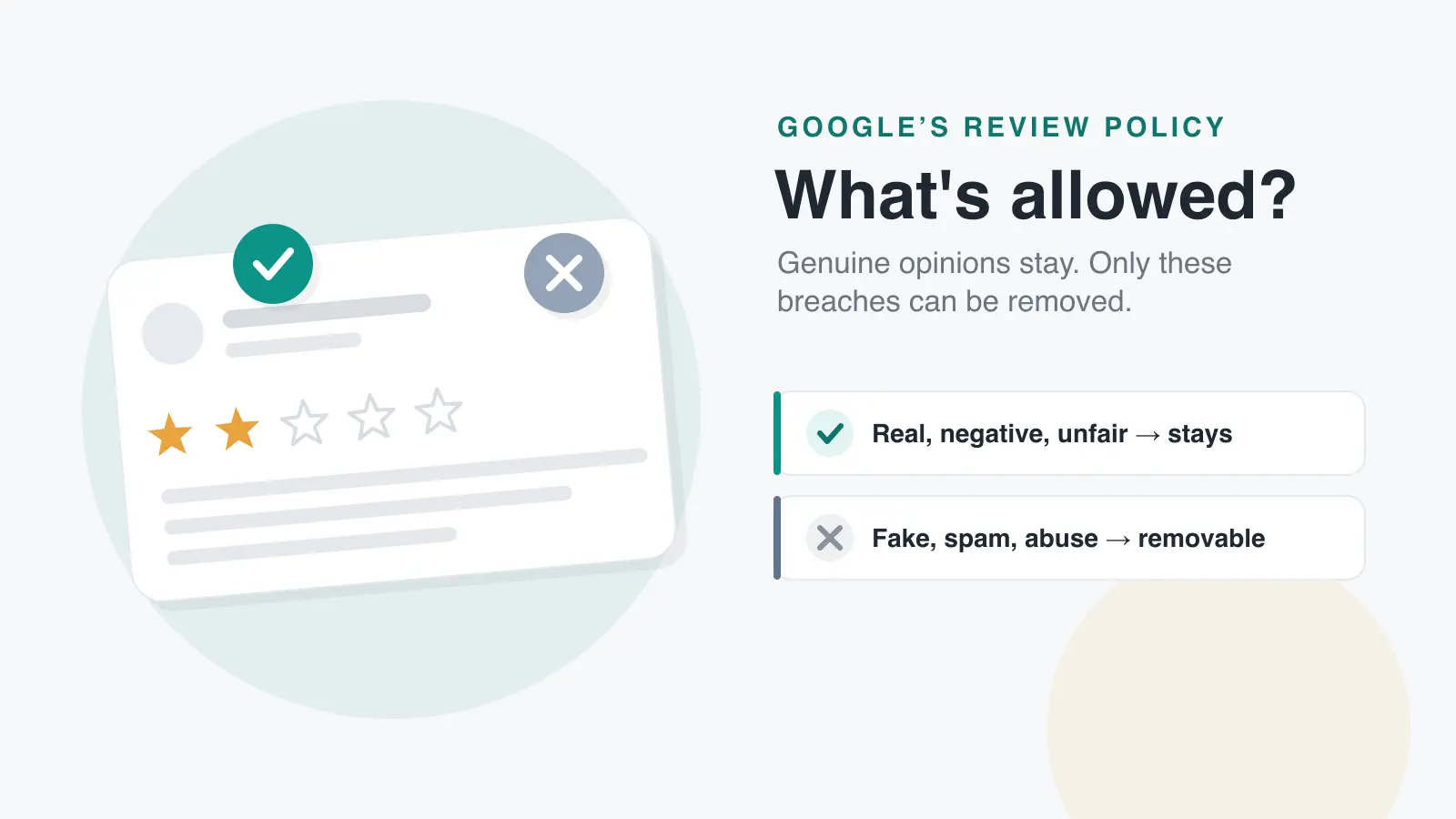
Google's review policy sets out what people are and aren't allowed to write in a review, and it's the single document that decides whether a review can be removed. In short: reviews must reflect a genuine experience, stay on topic, and avoid a defined list of prohibited content, fake engagement, spam, personal information, harassment, hate speech, explicit material, and more. A review that breaches one of those can be reported and taken down. A review that's simply negative, or that you believe is untrue, cannot.
Most businesses only meet this policy in a moment of panic, trying to work out whether a damaging review qualifies for removal. Read once, calmly. It's far more useful, because it tells you exactly where the line sits, and it stops you wasting reports on reviews that were never going to come down.
The two rules that underpin everything
Before the specific prohibitions, two principles run through the whole policy:
1. Reviews must be based on a genuine experience. A review should come from a real customer describing a real interaction. Reviews invented to boost or damage a business, by the business, competitors, or anyone posting on their behalf, breach this from the start.
2. Reviews must be relevant. A review should be about the specific place and experience. Political rants, commentary about unrelated matters, or complaints aimed at a third party are off-topic, regardless of how strongly they're felt.
Almost every successful removal traces back to one of these two. The named categories below are the specific ways a review can fail them.
The prohibited and restricted content categories
Google's policy lists the content that isn't allowed in user reviews. Here are the categories that matter most to businesses, in plain terms:
| Category | What it means |
|---|---|
| Fake engagement | Content not based on a genuine experience; paid reviews; posts from multiple accounts to manipulate a rating. |
| Off-topic | Commentary unrelated to an actual experience at the location. |
| Restricted content | Reviews that promote regulated goods, alcohol, gambling, tobacco, firearms, pharmaceuticals, adult services. |
| Illegal content | Content that is itself unlawful, or depicts illegal activity. |
| Sexually explicit content | Pornographic or sexually gratifying material. |
| Offensive content | Profanity or obscenity used to offend rather than inform. |
| Dangerous & derogatory content | Content that harasses, intimidates, or promotes harm against individuals or groups. |
| Harassment | Threats, doxxing, or targeted abuse of a person. |
| Hate speech | Content attacking people based on protected characteristics. |
| Personal information | Sharing someone's private details, a staff member's name, contact details, or identifying data. |
| Impersonation | Pretending to be a person or organisation you aren't. |
| Misrepresentation | Misleading content, or reviews driven by an undisclosed conflict of interest. |
Google also prohibits terrorist content, child sexual abuse material, and graphic violence, categories that rarely arise in ordinary business reviews but are worth knowing exist.
The rules businesses must follow too
The policy doesn't only govern reviewers, it governs how you collect reviews. Two rules catch businesses out:
No incentivised reviews. Offering payment, discounts, or free goods in exchange for reviews is prohibited. So is offering an incentive to remove or change a negative review.
No review gating. When soliciting reviews, you can't selectively ask only happy customers, or discourage negative ones. Pressuring customers to leave reviews on the premises, or asking them to include specific content, also breaches the policy.
Using the policy in practice
When a review lands that you want gone, run it through three questions:
- Is the reviewer a genuine customer? If not, it's likely fake engagement.
- Is it actually about their experience with you? If it's about a third party or unrelated matter, it's off-topic.
- Does it contain prohibited content, personal details, a threat, hate speech, profanity aimed at offending? If so, report on that basis.
If the answer to all three is no. It's a real customer, describing their experience, without prohibited content, then the review complies with the policy, however unfair it feels, and reporting won't remove it. That's the moment to switch from removal to response: reply well, and build enough genuine reviews that one critical voice stops defining you. A platform like Dinopix Reviews makes both routine, surfacing every new review, helping you reply in your brand voice, and automatically requesting reviews from real customers so your rating reflects the many, not the loudest.
Frequently Asked Questions
Does Google remove reviews just for being negative?
No. A negative review that reflects a genuine experience complies with Google's policy and will not be removed. Google only removes reviews that breach a specific policy, fake engagement, off-topic content, harassment, and the other prohibited categories. Being critical or even unfair is not, by itself, a breach.
Can a review be removed for containing swearing?
Potentially. Google's policy prohibits profanity and obscenity used to offend rather than to communicate. A review packed with abuse aimed at your staff can breach this; mild frustration expressed in strong terms usually won't. Report it under offensive content and let Google assess it.
Is it against Google's policy to ask customers for reviews?
No. Asking customers for reviews is encouraged, as long as you ask everyone rather than only the happy ones, don't offer incentives, and don't pressure people or dictate what they write. Asking selectively (review gating) or offering rewards (incentivised reviews) both breach the policy.
What happens if my business breaks Google's review policy?
Google can take a range of actions: removing the offending content, disabling new reviews on your profile for a period, unpublishing existing reviews, or displaying a warning to consumers that fake reviews were detected. In serious cases the profile or account itself can be restricted.
Where can I read Google's full review policy?
Google publishes its prohibited and restricted content policy in the Google Business Profile and Maps user-generated content help sections. This guide summarises the categories most relevant to businesses, but Google's own documentation is the authoritative and most current source.
Does the policy apply to Google reviews left through Maps and Search?
Yes. Reviews on your Business Profile appear across Google Search and Google Maps, and the same user-generated content policy governs them wherever they're shown. Reporting a review handles it consistently across both surfaces.
Sources
This guide draws on the primary sources below. Regulations change. Always check the current version.